
ELLEN WAGENER
artwork | audio | statement | galleries
artwork
audio 
(see also Making Art in Iowa and Art & Spirituality)
- An artist or a nun (20 sec. | 139KB): listen | read
- Creative process (57 sec. | 447KB): listen | read
- Landscape (30 sec. | 209KB): listen | read
- Passion via painting (34 sec. | 234KB): listen | read
artist statement
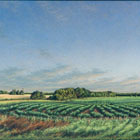
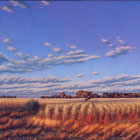
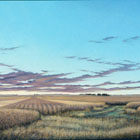
The Midwest prairie is remarkable. By virtue of being uninterrupted by mountains or an ocean coastline, the lasting delight for Midwest spectators depends on discovering more than is expected. I became interested in Midwest landscape painting because there were no confines except the edge of the paper and an everchanging display of color, rhythm, and texture out my front door.
Landscape painting is a method that expresses my inner response to and reverent feelings for nature. I look for connections between things—how one color flows into another, forms engage and separate, how one point in space influences another. The changes focused along the horizon are constant; they are governed by the seasons, the weather, or the cyclical nature of the agrarian landscape. There are no grand gestures, just subtle variations that, when combined, create a certain splendor inherent only to the Midwest landscape. I am seduced by the direct sensual colors and geometric patterns of the cultivated land.
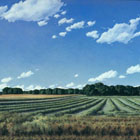
I convey in my paintings what is most pleasurable to me, such as discovering tenuous beauty in spontaneous cloud formations, and the repetition of endless corn and soybean rows captured on a rolling landscape. The overhead view is a critical element in my artistic sanity. After hibernating in the Rockies and five claustrophobic years in Washington, D.C., the panoramic Midwest skyline was a welcome retreat.
I think this area is rich. It sheds its skin a minimum of four times a year. Watching the corn grow and beans yellow under the saffron sun is a rigorous pasttime if you are paying attention. My paintings are about a presence, or a sense of place, rather than a specific site. They offer the viewer an opportunity for a second glance, something often missed while travelling the highway in a climate-controlled car.
audio text
An artist or a nun
I remember making the bed with my mom when I was about three years old, and I remember announcing to her that I would either be an artist or a nun. That was it. I was raised in a family that was Catholic, and I thought the two highest things that you could do with your life were to be an artist or a nun.
The creative process
The creative process for me really begins in springtime when I start noticing crops coming up. In the spring and the summer and until the early fall when it's warm and beautiful out, I get up in the morning and as I said, I like to go running. Then I like to drive in the car. I take a camera with me and sometimes a box of pastels and some paper, and I just start driving the country roads, in no particular direction at all.
So I take a lot of photographs, and I make a lot of sketches, and sometimes I do some small paintings when I'm in the car. Then I come back to my studio with those sketches and those colors and often samples of grass or corn or anything that I wanted to take from the landscape physically.
I'm not a painter who dillydallies around a lot. I don't make ten sketches of the place and decide. I get the piece of paper out, and if I have a clump of grass and six color markings on a piece of paper and maybe a photograph as a blueprint to remember what went where, I start working immediately. My sketch is the final piece that you see.
Landscape
I'm hoping that people will more look at the landscape after they see my work. Because when you see a big painting, you have time to stop and reflect and to look at it and to ask yourself questions, and yet people don't do that when they're outside looking at the same landscape I'm looking at. So I really want them to go away with a more open sense of looking at the sky and the clouds, and change of season and color and texture, and what colors the beans change—from emerald green in the summer, to a saffron yellow, and then to deep rusty reds in the fall.
Passion via painting
I can't tell you the number of times I've screamed out loud in the country and in my studio how happy I am and how much I love my life, and how beautiful this location is. It's kind of how I express my spiritual self and how I find the spirit in me.
If at the end of my life I had to watch a quick video of my life, I want to be able to know that while I was spending eight hours in my studio that I was feeling pretty good while I was doing it. And I do most of the time. I think that's what I was really destined to do, and I'm going to do it with as much passion as I possibly can. I want to find passion in my life, and I do via painting. And I'm pretty lucky that I get to do that everyday.