

MAUREEN A. SEAMONDS
artwork
audio 
(see also Making Art in Iowa and Art & Spirituality)
- Child artist (44 sec. | 300KB): listen | read
- Women (56 sec. | 384KB): listen | read
- Patterns (64 sec. | 441KB): listen | read
- Street studio (41 sec. | 278KB): listen | read
- Creative process (53 sec. | 364KB): listen | read
- Advice (52 sec. | 359KB): listen | read
audio text
Child artist
My Grandfather Kennedy painted, and it was really a mark of having achieved adulthood to have your own painting that he had done. His paintings were very treasured and very respected, and I think that that made a mark—that that was something that you felt was held in esteem. Although I think they were cognizant of the realities of careers in the arts, they would never have said, "Oh my gosh, why would you do that?"
I was one of those kids who drew a lot, and I think you always knew you were going to be some form of an artist. It's kind of like you get identified kind of early as far as, "Oh well, she paints or she draws." And they were very supportive of that—and if you did something, that they saved it.
Women
Women weren't very challenged to be anything. Teacher or a nurse. And that was very direct from the whole world. I think you have to get past that before you realize how pervasive those attitudes were and how socialized we were by those attitudes. I can remember going to my first League of Women Voters' meeting, and I had been married, had a baby, and was an adult, I think, for the first time. And I went to that meeting and I realized how long it had been since someone had asked me about ideas and opinions, like it mattered. And those were strong women. That was a watershed experience for me as a young married woman. And I think it really gave me the feeling that my life would matter, that it needed to be important enough to matter, to both me and others. And if I hadn't had people like that in my life, I think I'd have been really frustrated.
Patterns
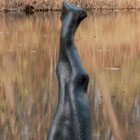
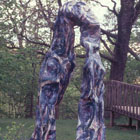
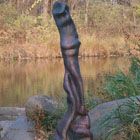
In graduate school, I got really interested in the movements of the landscape—the way the elements of nature interact. I was reading a lot of Jung and his behavioral archetypes and some other really theoretical science kinds of readings. And it strikes me that that whole interconnectedness in the physical world is so real. If you look at a cross-section of a human body done by MRIs, and you look at smoke patterns and the clouds and the snowdrifts, all of that, that little rhythmic push and pull dance—I love that. And so I began to play with that with clay, and the sculptures really evolved from me thinking about that. What I want in my sculptural figures is to have that kind of rhythm of the land that becomes very figurative, but it's very non-specific. That it has that sort of sense of humanity, but is not a person who has a name.
Street studio
When you're right on the street in a small, rural town, everybody is an art critic! And, you know, the passersby—there's some wonderful people from the street who just routinely stop in the studio. And, you know, they'd come in and they'd say, "Well, what are you making?" And they didn't care what I said, but meanwhile they would, like, touch the work, or they might hug it, or just kind of drape an arm across it. And I thought, they really know it, and they're responding really appropriately. It was nice to think that you didn't have to have a specific vocabulary or that you didn't have to have training in the arts to basically understand it.
Creative process
A lot of times I'm doing other reading that maybe is making me think about certain ideas or certain issues, or thinking of how I approach something in my own life. I don't very often draw the specific sculpture first. I do sketches, but they aren't very often of the sculpture that I will do. So, generally I start with the clay. I probably have a pretty good idea how big I want to work this time. Then I have to think about some of the practical considerations. At that point, I usually begin to work. About halfway through the actual forming, that's really nice. It begins to take shape; you begin to have this relationship with it. It's just exciting. It's kind of like when a painting begins to gel. Ooh, that feels good. You get just energized. The paintbrush moves faster. And I think there's that real knowledge that you're on the right track, and you're going the right direction.
Advice
I feel that as a professor, part of what I need to do is expose them to what the world out there looks like in the arts. And it doesn't need to be just visual arts, but where people truly give their life to the making of something original. That's a different model than we have here. And I think it's critical that they meet people who do that, and that support themselves doing it, or fit it into a life that nurtures them doing it. And then I think that just the simple learning curve of making in different environments and learning from different people is wonderfully expansive. That you just will grow and change, and it won't necessarily mean less of you, but it helps you find that you. So, I would really encourage them to seek both lots of other creative experiences and professional training.