
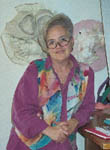
JO MYERS-WALKER
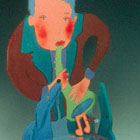
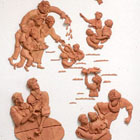
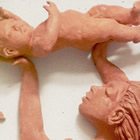
artwork

audio 
(see also Making Art in Iowa and Art & Spirituality
- Early art (48 sec. | 329KB): listen | read
- Making a living (53 sec. | 366KB): listen | read
- Foster parent (38 sec. | 260KB): listen | read
- Artwork (61 sec. | 416KB): listen | read
- Making art (28 sec. | 193KB): listen | read
- Critics (48 sec. | 327KB): listen | read
audio text
Early art
I liked to be alone and draw stuff, and whenever I could climb a tree, I was always up in this tree. Across the street we had a park, and I'd sit up there and draw and write stuff. And I never saved much of it or anything, but I needed alone time to sit and dream.
I remember I did a bird one time—it was about third or fourth grade—and the teacher put it up, and then she told my mother that I was going to be an artist someday. And the reason, I know, she was looking at the detail of the claws, the feet, the feathers, and she could tell that I noticed things, and I could record them.
I had the drive early on. Like, I'd go in at seven in the morning in the art room and do my work. When the other kids were going to basketball, I went in, too, because I needed to be there. I think that was my safe place—you know, where you feel comfortable—in high school.
Making a living
I was pretty controlled and dominated in my first marriage. In fact, I wasn't supposed to paint, because I was supposed to be a mother kind of person. So I would almost hide my painting. I mean, I'd do it, and then I'd tuck it away in the closet so nobody could see it. I was allowing some controlling going on there.
We got divorced. It was scary because he was in school; he didn't have a lot of money. So I needed to find a way to support the girls. I think, in a way, that was a real driving force to get my act together, because I had to put milk and food on the table. And I've often thought that had I not been in that situation, I might not have been so driven. I was going to prove to that man that I could do this. Because his family thought I should give my children to them, because I couldn't possibly make a living and support children, and.... And that kind of made me angry! So I thought, I'll show you!
Foster parent
I'm still doing a little teaching, but I'm doing it as a foster parent. So now I do a little quote "art therapy" in here with the kids. Because I think that's what kept me sane in my high school, junior high days, was being able to go sit in my tree and draw pictures. I know I have some kids that have had trouble with anger, and I say, "Well, here's your ten pounds of clay; this is for you!" And we laugh and we talk—we can recognize that, "Yeah, you have real crummy, frustrating days, but rather than hit my wall, please come out here and throw this around." And it works. So trying to take that creative side and direct it.
Artwork
When I started out with the girls, I did watercolors. And part of that, I know, was because if they ate them, they would not die! I like painting. That was probably my first love. So I made a living as a watercolorist. Then I started taking my watercolors that were not working and putting them in the blender and started making paper. Part of it, I didn't have a lot of money always for supplies, so taking things and reusing them, I think, made a lot of sense to me. Let's see, I got into puppets. Then I went on to the clothing line. I got in a lot of shows; that's when I started going to Baltimore with the American Craft Council, and showing there, and it really broadened my perspective. And then my dad and I started making wooden furniture that's weavy and curvy.
It's still exciting. And see, that is what people want to own and buy, is that passion and that excitement. It lifts them; it takes them someplace. I've tried to remember the power of my jumping around, and I think that's very powerful, if you use it right.
Making art
I learned early on that a lot of the making and the doing is the moment for me. I don't have to hold on to everything I make. It's the doing that's the high.
I've learned that in fifteen minutes I could do a sketch, just a beginning sketch, and then go to a meeting. And then I can come back and do another one. I've tried to take my time and make it valuable and not cry over the fact that I'm interrupted all the time. Because, I mean, who isn't? And I think if you think that, you'll never get started.
Critics
Some people are rude, in a way. They'll come up and say, "Well, my child could have done this." And of course, with playful artwork that is more childlike, there's a truth to that. But their child didn't. I try to just realize that they have a right to that opinion. It doesn't have to be truth for me.
Whenever you're putting your inner pain and stuff out there, you've got to expect that the whole world may not understand what you're doing, and you can't take it real personally. Sure, I get hurt—sometimes I'm reviewed and they don't get what I was trying to do. Everybody has an opinion; everybody's a critic. But I kind of learned early on that I couldn't let all of that influence me totally, or I'd quit. And what job is there where everybody loves everything you're doing all day long? That's very unrealistic.