
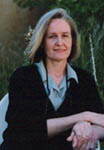
SUE HETTMANSPERGER
artwork | audio | statement | 2008 update | galleries
artwork
audio 
(see also Making Art In Iowa)
- Growing up (58 sec. | 399KB): listen | read
- College (53 sec. | 362KB): listen | read
- Children (46 sec. | 317KB): listen | read
- My art (60 sec. | 415KB): listen | read
- Creative process (57 sec. | 393KB): listen | read
- Cycle of work (66 sec. | 457KB): listen | read
artist statement
CHIMERA
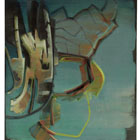
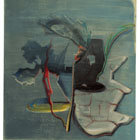
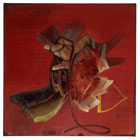
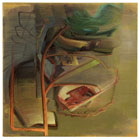
The language of painting embodies the morphology of form through process, materiality and its collaboration with the structure of space. Walking the line between abstraction and representation, the imagery of this series refers to the human body, botany, digital distortion, and manufactured objects. The internal rationale of the painting changes and shifts, as though the form travels through a topologically stretched space, changing its shape in accordance with unseen mathematical operations. Hybrid chimeric images acknowledge a present ethos of genetic and digital manipulation, reflecting the complex relationship of humans to their environment. This work seeks to mirror a current cultural perspective in which boundaries between organisms are increasingly blurred, and our awareness of digitally altered images makes us question the truthfulness of everything we see in visual culture. Musing on the interdependence of human and botanical, organic and inorganic systems in a conflicted embrace, this series provokes thought about cultural attitudes and perceptions of our place within nature.
2008 update
How has your life changed in the years since I interviewed you?
It has become more stable in relationships, but more poignantly felt that "life on earth is brief," quoting from a friend. As a senior faculty member at a research institution, there has been an increasing amount of administrative work. I continue to carve out time to work in the studio.
What kind of artwork are you doing now?
I am trying to make work that speaks of the current cultural moment and embodies the ability of painting to reveal this disjunctive and open-ended space as it is continually reinvented.
How has your artwork changed in the last ten years?
The work I made ten years ago was following the scientific approach of paring nature down to its singular underlying micro truths. Since then, my awareness of chaos theory, systems of complexity, and the digital arena have changed my approach. I would say that the images have become increasingly in flux, hybridized and collaged.
What motivates you to continue making art?
As I said in other words ten years ago, there is an inner freedom in exploring visual invention, an interesting place to explore the self and the world.
audio text
Growing up
We lived on a dirt, dead-end road which was very significant. And there were little kids in the neighborhood, and we would all do things together. And then when we moved to New Mexico, nature became all consuming; it was huge. So it was just a quiet, rural kind of upbringing, as opposed to the city, and I value that a lot.
I was always one of those ones that wanted to demonstrate my skill and be like the classroom skilled person in terms of drawing things. So I just always was trying hard, I guess, to get attention, to get love, to—whatever, and I guess that was a way to do it. There weren't any art museums I think at that time in Albuquerque, and museum—going wasn't an activity that we had. It was only when I got out of high school and into the university that I realized that these institutions existed outside and that this thing could go on a lot further than I had imagined.
College
When I got to the University, I was thinking in the practical sense, what can you do that will get you a job? So I was taking art as my minor and journalism as the major. And then by the time I was a junior—I think it was the foment of that time period and the interest in philosophical ideas—and suddenly I realized that I was this impractical idealist and that I really wanted to go into art, which was very impractical, and not use it as a commercial venue. In all my classes, we were talking about Duchamp and Rauschenberg and all of this exciting avant garde stuff that was happening. And learning about that was quite an eye-opener—new ways of seeing the world, new ways of thinking about things, ways of questioning the status quo—all of that stuff was just so interesting to me.
Children
Children—definitely they need all your attention, and I just couldn't do that. I had a couple of opportunities to do that, and I just couldn't see how I could continue to do this at the level that I wanted to do it. I've always had this ambition to be at the highest level of the field. And I just could not imagine being able to do that. I don't know how it would have been. Maybe it would have been the same. Maybe I'm missing out on something really great. And I have those thoughts, too. And those moments are very hard. I don't know. I have to think that I've made the right decision. I don't think everybody is meant to just automatically fulfill their biological destiny that way.
My art
It's very difficult to actually see your work for really truly what it is. Early on, the feeling that as a young woman you're supposed to please everyone, my work was very pleasing. And now, hopefully, I've crossed over into a realm where I can do exactly what I want to do, whether or not it's disquieting to others. It celebrates things in life. But at the same time I feel like I try to interject a disjunctive element, a difficulty, which is reflective of my life experience and what I see going on in the world and in the culture at large.
Some of the earlier plants that were floating with their roots sort of upended and disoriented have also been a metaphor for my life, I suppose. I think that this generation has had to reinvent—maybe all generations do, reinvent what is true. So there's a bit of a feminist thing, too—a sort of celebration of the life of a woman artist trying to define herself and her relationship to her world.
Creative process
I think some of my happiest times as a human being have been when I'm coming up with an idea and making it in visual form. It's the result of a long learning process. I go to books a lot for ideas and sometimes for imagery—science books and things like that. Being able to put something together like that and come up with something that no one's ever seen before—an image that's new in a sense—there's something very exciting about being able to do that, and satisfying.
If I weren't an artist I would probably be either a biologist or an environmental activist. I've done some environmental activism, too. But that lacks this sort of creative spark. It's a more practical, analytical realm. I like the analytical and the intuitive being brought to art.
Cycle of work
I think that there are unrealistic expectations for artists to be constantly cranking out imagery all day, everyday, you know, every year, year after year. I think that that's why we see some work which is just redundant. For me, you have cyclic periods—it's a rollercoaster, actually. You can be at a very low point where you're not very inspired to do anything. Those times are difficult. Although the older I get the more I'm able to go through those periods and still make things to a certain extent, because I feel like I've learned more what to do at those times. You read a book, and then you're inspired again. I'll go for a walk in nature and bring back things to the studio to work from. Because you're constantly coming up against new ideas in your life, and so your work should reflect a kind of discovery process of what you've learned up to that point in your life and how it can be manifested in an object.