
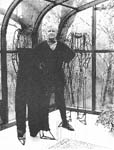
MARILYN ANNIN
artwork | audio | statement | galleries
artwork
audio 
- Early art play (26 sec. | 181KB): listen | read
- Later art-making (18 sec. | 121KB): listen | read
- Audience (37 sec. | 255KB): listen | read
- Time and art (29 sec. | 200KB): listen | read
- Process (40 sec. | 276KB): listen | read
- Advice (39 sec. | 268KB): listen | read
artist statement
Several years ago an associate suggested that I temporarily set aside my brushes and move from painting to sculpture. The opportunity came in a class experience that focused on teaching painters to think in three-dimensional terms and it forced me to move from painting's comfortable territory into the uncertain realm of sculpture.
My approach to sculpture was casual and informal as I decided to experiment with common materials such as safety pins, buttons, can tabs, bottle caps, neckties, broken jewelry and many other discarded or forgotten objects. I frequented flea markets, salvage or resale stores, and garage sales. The process of collecting and gathering these ordinary objects seemed to elevate them above the common-place.
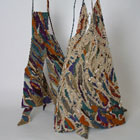
The next step in the evolution of my sculpture experience came after several months of handling these gathered objects. I remained uncertain where it was leading until a fellow artist picked up a half-finished piece I had been working on and threw it over her shoulders. As this scrap of "art" conformed to her figure, I saw the wide-ranging possibilities of a new medium.
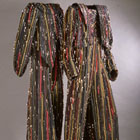
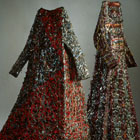
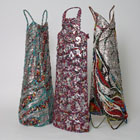
With that recognition, my involvement in sculpture expanded from the technical aspect of making art into working with ideas: a series of sculptured garments with each acting as a metaphor for a specific attitude or custom of our culture. I have focused on garments as portraiture, as commentary, and as satire.
My process begins with a welding torch and quarter-inch steel rod. The resulting armature can function merely as a support or it can play a definitive role in the design of the piece. The materials that are selected and worked into the fabric contribute to the meaning of the garment. The meticulous nature of the construction and the combining of dissimilar materials tend to draw the viewer into the work. In return, the viewer completes the process by bringing a personal interpretation to the piece.
audio text
Early art play
The early playtime was spatial; I was arranging things. And I really bonded with a space that I created and I could play in. It could be a tree house or it could be rearranging furniture within a room, or raking leaves into a leaf floor plan of rooms. That was my strongest gratifying play as a youngster.
Later art-making
The actual art-making was private until about twenty years ago when I went back to school. Took lots of classes, and I ended up studying, then, one-on-one with several really important people. I finally could be self-centered again.
Audience
I think the audience is important. Your art-making has to communicate something. There has to be some kind of intellectual place for that art-making. The letting go of it, presentation of it, sitting back and then letting it represent you in whatever thought you had as you were doing that art-making—that's important, to me. It's narrative art. And I'm commenting in a visual format rather than verbal what my attitudes are—sort of middle America, middle century, female attitudes.
Time and art
When I'm art-making I like to be effusive. Time is money in our culture; and when I'm art-making, time is nothing.
For me, painting is demanding and I jealously guard my time. And I get adamant when I'm interrupted, and in fact, just won't be interrupted. Whereas, doing sculpture, it's much more of a social activity and I can pick it up and put it down, and look at it this way and that way, and if I tear down something I don't get hysterical. I think, Oh, this is interesting. Well, let's do it another way.
Process
I think the process is the most important. I kind of reinvent things because I change materials. A clay artist is always going to work with clay, maybe different kinds of clay, different kinds of glazes or firing or whatever, but the clay is it. For me, the only thing that's it, is the armature. After that, my process varies. I may spend six weeks just experimenting with materials before I get going. And it's that curiosity that carries me through to the end. Often I don't really start getting cerebral about it till close to the end, where I start editing and really designing and looking at the piece as a whole.
Advice
It's important to realize that it's a process kind of a career. And that if you go to school and are trained, that you're not going to get spit out into society as, necessarily, an artist. It just comes; it evolves. It's hard to say, "Well, I'm an artist." I mean, that's for somebody else to say. It's the discipline. It's hard. It's unforgiving. And yet, there's lots of opportunities. The sky's the limit. You can do anything you want to do in art-making, as long as you're convincing. Well, what a wonderful format in which to operate!