VICKI ADAMS
artwork | audio | statement | galleries
artwork
audio 
- Switching to art (19 sec. | 135KB): listen | read
- Printmaking (36 sec. | 253KB): listen | read
- Turning point (29 sec. | 199KB): listen | read
- Making art (48 sec. | 324KB): listen | read
- Advice to new artists (19 sec. | 137KB): listen | read
artist statement
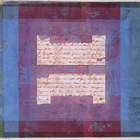
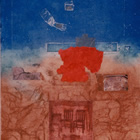
I am a printmaker and papermaker. Most of my works are abstract and reflect my interest in nature. While a printmaking student, I became interested in the collagraph technique (printing from a collage). The subtleties and surprises of this method are especially appealing in abstract prints, overprinting to produce rich color combinations.
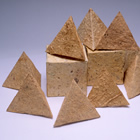
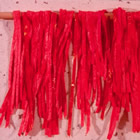
My handmade paper is made from recycled paper to which dyes and vegetal materials are added for subtle colors and textures. These papers are then printed on, and shaped into three-dimensional reliefs or constructed sculptural works. My most recent paper works have been solid shapes such as pyramids and cubes in various arrangements.
2008 update
Although I'm ten years older than the last time you interviewed me, I seem to be volunteering more than ever. My special interest is in NAMI Iowa where I volunteer in the library and write short book reviews. I volunteer at the Heritage Gallery once a month and enjoy seeing other artists works. This winter I guess you could say I've been on an art sabbatical, as that sounds better than I have "no new ideas". However, after taking time off, I was inspired to print over one of my collagraphs last week after seeing a beautiful piece of pottery in a magazine. It is not finished.
audio text
Switching to art
I thought I wanted to be a music teacher, but I did not like to perform. I was very nervous and shy about performing, so when I played the piano I was a nervous wreck—and singing, too. I'd get so self-conscious that it was uncomfortable for me to sing. So I think that may have had something to do with my switching to art (laughing).
Printmaking
I took my first printmaking class in 1970. I first did a woodcut, and I liked that—a colored woodcut, and then a linocut, and it just was very exciting to me. But then, I really wanted to do etchings. So I got involved in intaglio printmaking the next year, and I just went on and on and on from there. I work now mostly with collagraphs, which is a collage glued to a mat board and then that is inked up with a roller, or it can be inked up with the intaglio method of applying the ink and then buffing the surface off.
Turning point
I did more objective things in printmaking at first, and then my graduate project was the blacks and lights of intense light on the subject, and how it blended with the background—the environment. And it became very abstract-looking at that point. I had done some abstract art before that, but that was really kind of the turning point I'd say. I was more interested in textures and colors and shapes than I was in defining some object.
Making art
The reason I make art is to create something that I like looking at and hopefully someone else will, too. There are times when I make art that I don't like, and I hide it under the press and leave it there for a few months, and then I find later on I'll use part of it in a collage or some other work.
I really like to experiment. And if I don't like one color combination, sometimes I'll print over it completely with white or a light color or a dark color, and get something completely out of the ordinary, and it's fun to see that happen. The thing about printmaking is you're never sure how it's going to turn out, because when it's printed, it's printed backwards from what you're seeing when you're creating it. So, you have to kind of go with the flow.
Advice to new artists
Just keep working at it and don't give up, because you can always put it away and then take it out and do something else with it later. And not to be too dissatisfied with your first experiments—consider them experiments rather than a finished piece of art. You're working toward becoming an artist, and I'm still doing that.