
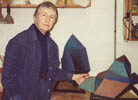
MERLE ZIRKLE
artwork
audio 
- Childhood (60 sec. | 410KB): listen | read
- College (43 sec. | 296KB): listen | read
- Artwork (39 sec. | 267KB): listen | read
- Paper clay (58 sec. | 400KB): listen | read
- Creative process (34 sec. | 234KB): listen | read
- Advice (42 sec. | 288KB): listen | read
audio text
Childhood
I was the ninth child; there was about six-and-a-half years between me and my youngest sister. My mother was widowed very early—I was within a few days of being four years old. So my mother, then, was the major influence and so then she had to become the farmer and manage everything. And it was not easy for a woman in those days.
First started out in a little country school the first couple of years. And then we were included in the Oxford District. So that was a big change, you know, that was sort of intimidating. And I thought I did very well, considering. I had my art starting up as an avenue of expression.
I think it was in about the sixth grade, I did a lot of artwork on the chalkboard—colored chalk. I remember doing the Taj Mahal. And then I did some kind of Greek temple. And these were all, you know, admired and photographed, and I think I even had a thing in the paper. So that was kind of fun. I enjoyed that.
College
I took about two courses in everything, practically. I was in painting, and ceramics and sculpture and printmaking and jewelry. So I was just partaking of all those things. Finally we had a guest artist—Carleton Ball was his name—and he was from Southern Illinois University. I was impressed with him; he did a fine job in the ceramics workshop that he did. And I thought, well, you know, I'd like to study with him. And when I got ready to apply to different schools, I applied to Southern. I got a fellowship, and later when I got there, an assistantship. But in the meantime, Carleton Ball had gone somewhere else, and I got one of his former students. So, it was a good two years. I worked very hard, I enjoyed it very much.
Artwork
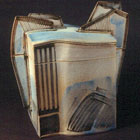
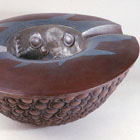
It's ceramic sculpture. Sometimes I've combined wood with the ceramic part, which is usually stoneware. And I've gone through different phases, various types of vessels that are fairly nonfunctional, but could function. I was, and still am, concerned with surface treatment, embellishment of some sort.
My work is pretty formalistic in a sense—I'm dealing with, you know, the material and the principles of design and order, and I'm trying to make things work visually. And I don't often get into things that are real strong commentary. I usually use nature as a reference.
Paper clay
I went to a conference out in San Diego and I attended a workshop, and this woman was talking about paper clay. What you do is make paper pulp and put it in with your heavy clay slip, and then you spread this out and make slabs, and then you fabricate. And the paper pulp takes up part of the bulk, of course, and then it burns out, and you have a lighter piece. And you can be quite thin, and it's very strong.
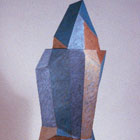
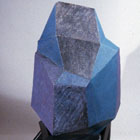
But anyway, I started doing paper clay works, and that became the Crystal Quest series. I got rid of all the rounded forms, and started making things with planes. I used underglaze colors on the outside instead of glazes, and that would keep a dry surface for the most part. And then when I didn't completely like that, I would use some acrylic and keep it matte-like. And I could work that surface and change it and paint on it and do things that I couldn't do if I just glazed it. I determined that I would not box myself in with that.
Creative process
You just never know where you're going to go. You can't possibly plot out a five-year plan in art, at least I can't. Because I get inspired with a certain kind of idea, and that carries on through a series, and that goes on maybe six months, or it might go on six years. So it just depends. And sometimes, I get tired of a particular kind of series that I'm doing. I get excited about something else, well, I'll move to that. And then I might come back to the original series after a period of time. I've gotten kind of a different eye for that, and I've come back thinking about it a little differently.
Advice
Well, be prepared to work very hard. It's not an easy field to go into. And just don't give up. Now you might have to work in some other livelihood to make sure you have food and shelter, but just don't stop, because I think you never know. You'll get there, and maybe you can make a living off of it, if that's the way you want to. But I think it's so enriching for people who don't want to make it a life's work; if they just do it as an avocation.
Just be prepared that you're not going to get by without working at it, if it's going to be any good. Most of the time, if it's that easy, you're just not pushing it hard enough. You're not challenging yourself enough. You're not growing.