
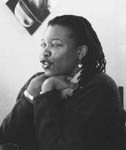
GELSY VERNA
artwork | audio | statement | first-person narrative | memorial page (third-party)
artwork
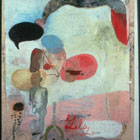
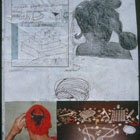
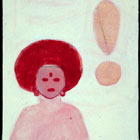
audio 
(see also Making Art in Iowa)
- Growing up (46 sec. | 316KB): listen | read
- Shapes & fragments (22 sec. | 153KB): listen | read
- Making art (50 sec. | 339KB): listen | read
- Living in Iowa (50 sec. | 339KB): listen | read
artist statement
The process:
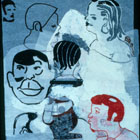
My images develop through sifting, moving things around. Layering indicates adjustments of my consciousness through time. What I seek is a balance between what I am describing, the process of discovering the elements that organize the picture, and the meaning which results. I would like to think that it is possible to say that the painting paints itself. That the meaning in a painting not only comes from the juxtaposition of the elements painted, but also through the means by which the paint is applied. I am interested in simplicity of means.
I am eclectic in my personal taste and its manifestation is present in my artistic process: collection, accumulation, layering. I like the idea of the "found object," collected in the cities, at flea markets, in classrooms. These fragments outside their original environment, resist naming; opening these "founds" up for new meaning and musings.
These strategies allow me to explore issues of identity (cultural, personal), including broader examinations of consciousness and memory. On one hand, I enjoy spontaneous gestures and on the other, I want to stand back and work out a determined path. The spontaneous gives me a feeling of freedom to start anywhere, not knowing where it will take me. It is like casting a net in your mind and looking at what has caught in it; sometimes the old shoe appears, at other times, a gem.
The collage and layering function on a metaphorical level, as I explore cultural, social identity. I grew up in a land, Canada, that is different from my land of birth, Haiti. I work in a land, America, that is different from where I grew up, and live in my second language, English. Traveling has made me aware that my perceived and projected identity varies depending on my geographical location. I am aware that a reading of my work sometimes points out the issues of identity, difference. However, I also come to painting liking what paint and painting can do.
My memory disfigures my feeling
My imagination disfigures my memory
My sources vary.
—Marlene Dumas
audio text
Growing up
I've always wanted to be involved in art, but when I was growing up, I always said I wanted to be a doctor like my dad. And the only prize I won in high school was a biology prize. So it was kind of, Okay, this is what I'm going to do. I'm glad I didn't even go into art at first, because I like to think that I messed up someplace else, and then got my focus in art. For me, art is the place that gave me my self-confidence, even though sometimes I shake my head and I can't believe. I mean, it's a field where you're kind of walking with your heart on your sleeve, and this idea of self-confidence through that. But I think there was always this little voice—or I would tell it to myself, I think you can do it.
Shapes & fragments
I like shapes. Maybe apart from shapes, I like fragments in a sense that a fragment can give you a point of entry, but because you don't have the whole, you could imagine. It's almost like the Venus of Milo—we know she's standing, we know she's twisted, but what were the arms doing?
Making art
I don't think I'm painting emotion or drawing emotion, but that emotion could come through how one treats the material. That there's something how your body responds to it. That has been a little bit more clear to me recently, because I went from, in my artistic life, wanting things to look real, to being interested in the surface, like how paint gets applied. And being more abstract to coming back to having a bit of both, abstract and namable things. And also, using collage, and the idea of collage is maybe bringing things that have a different history of origin, but the synthesis of them makes something that when they're apart, you can't see it. It's like, how they come together.
Living in Iowa
When I first moved here, I didn't think I could work here. I would always think, Oh, I need to go back to Chicago because at the time I was really interested in finding things on the streets, and collecting pieces. And then I thought, well, how can I do this here?
For me, Iowa works on the sense where it allows me to focus as a teacher. Then there's something of that, that goes to the studio. But I can only do it with enough traveling. Being able to go to the places where you get questions or you get answers, and then you can come back to your studio and do it.
When I spent a year on the East Coast there were times I was like, Oh, I can't believe I'm wishing for Iowa. But it was like the quiet, the taking a breather. Iowa gives me more of a kind of interior life.
first-person narrative
Locating What's Important
edited from interview | copyright © 2003–2026 Jane Robinette | All Rights Reserved
Artists have always needed encouragement, have always needed people that support them. Art is believing in something or investing in something that may give you a return, or at least someone needs it. Sometimes as a woman artist there's that struggle of trying to figure out how do you make that thing important, even though you know it may not have any value. And other artists understand—like writers and all—this idea that for some reason, it's important. It doesn't represent money the way stocks could represent money, but I feel it's important.
*
I come from a family of eccentrics. There's six of us and four are involved in art. I know a little bit more about my dad's family than my mom's family, but one thing they seem to have in common is, they like an independence of mind and to chart their own path in some ways.
My mom is street smart, and she knows how to cut the fat and get to whatever needs to be done. I'm still challenged by the idea that she always worked, always wanted to work, and raised six kids. That I don't think I could do. She was always curious, always trying to supplement our school education. My mom was the one always coming up with new ideas of what we could do, how we could spend our summers. My dad seems quiet, but he's just full of knowledge. He's a very curious person. He thought about everything, and he just didn't seem to be able to do anything wrong. Growing up, how do you not be in awe of somebody? But also you're challenged, because this person is very determined in some ways and that was intimidating.
In retrospect, I realize that my parents put a lot of energy in bringing us up and our well-being in a way that one doesn't realize, like the effort of learning and school. My mom realized that we needed to speak English, so she sent us to the YMCA summer camp. All in our family studied music. We each had a time to practice, and mine was early in the morning practicing my violin. My parents raised us with things they didn't have or they wanted us to have.
*
I remember going to the park across from our house, and there's this piece of root that I found, and I brought it home and I said to my dad, "I think I want to do something with it." And he said, "Okay, well, I'll buy you some sandpaper, and what about if you sand it and then you varnish it with something, or stain it." The thing that was interesting to me is that it was a root, but it reminded me of a fish. I like shapes that remind you of something else.
When I was about maybe ten or eleven, I had this kidney operation and my mom brought me this paint-by-number painting to do, and I still have it with me. When I was a bit older, on Saturdays, I would go to this art class. Basically, we got there and we did anything. There was all these different levels of kids. I remember seeing people splashing paint and not even understanding, not thinking of Jackson Pollock or anything, but going, Oh, let me try this! I never remember being bored and I never remember missing it. I like that aspect of art—teaching art with this idea of discovery and presenting something, and copying and not going down to always thinking about what everything means.
*
I've always wanted to be involved in art, but when I was growing up, I always said I wanted to be a doctor like my dad. And the only prize I won in high school was a biology prize, so it was, Okay, this is what I'm going to do. I'm glad I didn't even go into art at first, because I like to think that I messed up some place else, and then got my focus in art. For me, art is the place that gave me my self-confidence, even though sometimes I shake my head and I can't believe. I mean, it's a field where you're kind of walking with your heart on your sleeve, and this idea of self-confidence through that. But there was always this little voice—or I would tell it to myself—I think you can do it. I always knew—even in science—that I had a good visual memory.
The switch to art was really hard at first, because I had to let go and say, You just choose something else and it's okay. It's this idea of identity with what you grew up seeing and who you identify with—or this idea of expectations. Once I let go of all that, it just felt good. I went back home and then I started taking night classes in figure drawing. I got an A in the class. After that, my mom had come across something that talked about Paris American Academy. The summer of '85, I went and attended this program, and it was the first time I was in an art context as an art student. It was really good. On my return, then, I decided that maybe I was going to try to go to art school.
*
I was twenty-five in 1986, and I had gotten accepted at the School of the Art Institute of Chicago. I really had a great experience. In some ways I felt I was given this second chance. It made me more focused. For two-and-a-half years, I only had studio and art history classes. I was very new at it or naïve. But I got some teachers that were really good. The first year, I remember that I wasn't really aware of contemporary artists, but I would always write artists' names down and try to go to the library to see if I could match at least a name and an image. So I always think of my first year as this catching up.
For my undergrad, Betsy Rupprecht is probably the one that did the most for me. She was teaching this figure drawing class, and her approach about it was based on the push and pull by Hans Hofmann. I took the class three times; most people took it twice. She used to tell us, "Okay, buy two sheets of paper, a chamois cloth, and charcoal. Don't even buy more, because if you're lucky, you get two good drawings." She taught me composition; she also taught color. She taught me how to pay attention to composition in a way that, even if you'd put the model in front of you, it doesn't exclude imagination. She always used to say that you draw with what you see and what you know. I keep coming back to the things that I learned from her. She really gave me a good base. Another teacher, Ray Yoshida, that I took for advanced painting studio—I used to say he's the one that opened up my soul, because he's the one who took me from undergrad to graduate.
One of the reasons I stayed in Chicago at the Art Institute for my M.F.A. is because I hadn't done four years there. I got a lot from the Art Institute. Just the opportunities—like having the museum is an amazing thing. I used to think of the museum like our living room. All the shows were free for us, and it's kind of, "What are these people doing here?!" It was a good experience.
For one semester I went to Germany, and that was really good. I knew I wanted some place totally different. It was hard as an experience because it wasn't what I expected, but I could deal with changes. I've gone there three times afterwards. When I was in Germany, I was more successful in my prints than in my paintings. Part of it is that printmaking offered us a camaraderie with the people in the shop, because printmaking is process-oriented, whereas painting is more of a lonely pursuit. I always try to encourage my students to travel, because I tell them that traveling is like putting a mirror to yourself, and seeing how you cope with not knowing rules, and you have to see how you function. That's the best way to know oneself.
*
I like shapes. Maybe apart from shapes, I like fragments in a sense that a fragment can give you a point of entry, but because you don't have the whole, you could consider it as is, too. It's almost like the Venus of Milo—we know she's standing, we know she's twisted, but what were her arms doing? I don't think I'm painting emotion or drawing emotion, but that emotion could come through how one treats the material. That there's something for your body to respond to. That has been a little bit more clear to me recently, because I went from, in my artistic life, wanting things to look real to being interested in the surface, like how paint gets applied, and being more abstract, to coming back to having a bit of both—abstract and namable things. Also, using collage. And the idea of collage is bringing things that have a different history of origin, but the synthesis of them makes something that when they're apart, you can't see. It's like, how they come together. I also realize from that, that sometimes the surface—how paint or how something gets collaged to something—also adds a narrative or a history. So I may start a drawing looking for sensation or knowing when to stop because it gives me a sensation. I guess that's how I mean by not painting emotion, but looking for it—it's in the materials.
I'm also intrigued that in some societies they work with code that we consider abstract, but they mean something. In some groups or tribes in Burkina Faso, let's say, the checkerboard pattern means knowledge, wisdom, and youth. The white is youth and the black is knowledge. So for them, the way to represent these two notions is the checkerboard. And for us, we could come to it and see it differently. But it doesn't mean that our interpretation, our conclusion, wouldn't be good. I don't really subscribe to this idea that a masterpiece is something whose light just goes across time and we all understand it the same way. I think it's nice that people may have another way to see it, or may have another interpretation.
A good piece for me would be a piece where somehow the means used to make the image connect with what I'm trying to say. And that doesn't always happen. Sometimes I go too far and I mess it up. But it's trying to find this moment where in the doing I discover something.
*
I started doing art because I liked it, or people would tell you you're good. But it takes more to continue. I like the idea that I'm trying to sit at this table where there's the word visual in the middle, and that it could be divided by painting—painting is this other subtext. But it's just trying to struggle to figure out—well, there's all these possibilities. The sky is the limit. If you pull the right thing out of it, you're saying something. But yet, there's no guarantee, it's only when you pull the right things. And because you're interested in pulling the right things, then you pay attention to things. It's the whole cultural memory that we share that we have to pay attention to.
I think of Jasper Johns doing the American Flag—visually, this idea that he wanted something that we could name and recognize, but then what he did in the materials sometimes contradicted that, worked in a different way. I feel like all the visual artists are playing in some ways that way. I don't think, having said that, that my ideas are always clear of what is my subject matter, what is the limits of it or what is my definition I'm working with. But hopefully, in my life as an artist, there's some things that are going to come clearer, and some things that are going to be constant, or some things are going to change. Sometimes it's very overwhelming; it seems like it's an impossible task. Like my teacher used to say, ninety-five percent struggle, five percent enjoyment, but when you get the five percent, you have to enjoy it a hundred percent. I feel like visual artists have this rolodex of images, and that you see something, you connect to something, and the more you see, the more you connect things. And then you could decide why you choose this and not that. It's crazy, because there's all these possibilities, but there's this elimination process that is needed for things to make sense.
*
Outside of doing my own work, I've had this interest in African art and things that have to do with Africa, because of my experience there growing up. Also, I'm interested in outsider artists, just because of where they connect with us as artists. They know when things are right or wrong, or they have a way to gauge—they choose their materials the way we choose our material. They exclude certain things, include other things. I'm always amazed about some of the artists; there's a sophistication in their use of materials that I don't think a lot of people pay attention to. Like this guy who makes these wonderful images that are symmetrical, that you could connect aesthetically to Indian art, because of his means of making them, the colors. Sometimes they have a lot to teach us.
I'm a little bit like my mom—I like objects, but different kinds. I have this collection of shoeshine boxes. I started after going to one of my teacher's houses, who rivals my mom in terms of objects. I saw this shoeshine box, and that's just how it started. I liked the idea attached to the object. I like the handmade ones, because I like the idea that somebody made it. All these objects have the same function, but people find a different solution to meet that function. Collecting is this idea of following a story and seeing where it takes you. In collecting objects, you meet people and people give you stories, how they got it, where they got it. I guess in art, or life maybe, stories are at the center of it.
*
When I first moved here, I didn't think I could work here. I would always think, oh, I need to go back to Chicago, because at the time I was really interested in finding things on the streets and collecting pieces. Then I thought, well, how can I do this here? This idea of the city was very important. You see something, you react to it. I need that. I'm always in my head here. Iowa allows me to focus as a teacher. Then there's something of that that goes to the studio. But I can only do it with enough traveling—being able to go to the places where you get questions or you get answers, and then you can come back to your studio and do it. That's how it's worked for me—being here and being gone and coming back. When I spent a year on the East Coast there were times I was like, Oh, I can't believe I'm wishing for Iowa. It was the quiet, the taking a breather. Iowa gives me more of a kind of interior life!
*
I do like teaching. But when you start right out of school, you're trying to do two things. There's this pressure of your career, and then you start teaching and you're trying to learn how to do that. So, for the first four years it was scary, because where do you allow yourself for transitions and changes? Even now, it's still a big struggle. It took me a few years to feel that I could give students something. Nothing in an M.F.A. prepares you for teaching. Nowadays, it's so competitive, and a university or school wants you for so many different reasons, and it doesn't always have anything to do with are you good or not. If your work resembles what two-thirds of the faculty does, then they'll look for something different. So those kind of things are not always so obvious.
*
I have this rule, I never tell somebody they should be an artist or not, because I think that you have to want to be an artist even if nobody believes in you except yourself. It requires that sometimes. I know some friends that are definitely going to be artists. For me, there's always been this doubt—I just don't know. Maybe, for me, that doubt has been good, because maybe I work from doubt. But there are times where I have to think, well, if you doubt too much, maybe you shouldn't do it.
Of course, everybody wants to be famous or wants it to be accepted. But people want it in different ways. I like to say, "I'm not going to jump in the water, but if you push me, I'll try to swim." In some ways, I've done more than I expected. In my horizon, I couldn't dream of what teaching at a university level entailed. I couldn't dream of how you are still an artist, but you're different. If I wanted to be totally successful, well, maybe I wouldn't take a teaching job. Maybe I would divest myself of everything so that every waking hour was into making the next painting, thinking about it.
I realize that every artist that I met that is successful, there is a total commitment in their art. They become this enterprise and everybody attached to the enterprise know what they're working for. The people I know that earn a living based on their art, they're 24-7 on it, and I don't think I am necessarily that way. It's interesting, sometimes you meet people that are mid-forties that have achieved success, and they have no personal life. It's a great challenge. Everyone has to acknowledge the things that we trade to be able to do it. In life it's maybe like that for me, too. I feel that you become successful in some ways in trying to juggle that—like locating what is important and going for it. It's hard. That all goes back to why it has to be a personal thing—somebody has to know if that's important for them.