
CRIT STREED
artwork
audio 
(see also Making Art in Iowa and Art & Spirituality and Beyond 9-11: The Art of Renewal in Iowa)
- Child Art (52 sec. | 362KB): listen | read
- Gardening (35 sec. | 246KB): listen | read
- Artwork (59 sec. | 408KB): listen | read
- Art-making (52 sec. | 357KB): listen | read
- Creative Process (45 sec. | 313KB): listen | read
- Advice (39 sec. | 269KB): listen | read
audio text
Child Art
I was always making and drawing and constructing things. I can remember setting up a little orange crate stand one time and making books with masking tape and paper and glue. Right from the beginning, art was always something that I knew innately—I didn't know that it was art, but I knew this thing of making my world. I remember in grade school having some recognition for my ability to draw representationally—that's unfortunately how sometimes things get recognized. But I thought it was kind of amazing myself.
I had very little experience really with art museums. I had lots of picture books available, and I remember being really drawn to the German Expressionists group—the abstraction of that and the color of that as a really very young child.
Gardening
I'm an avid gardener. I am very conscious of my environment, my living environment, and I think that's an extension of my art-making. It is about what you live with visually, and that's important to me. Also, after my daughter died, I think gardening really—that and my art—both of those things were a tremendous refuge. The gardening really was a way that I could somehow construct this growing, living thing. And we had gardened, and she had planted some carrots, and I kept those coming back for ten years.
Artwork
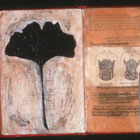
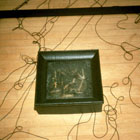
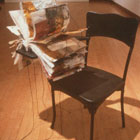
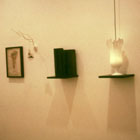
My art is using, really, conventional media and a lot of times conventional imagery, whether it's abstracted or representational, but generally it's work that gets put together in very unconventional ways. I'm interested in relationships, interconnections, how fragments or individual things hook up and then make new kind of Gestalts—how they then become bigger and carry some kind of experience or meaning by the configuration and the literal relationships. So I use two-dimensional, three-dimensional, constructed, found, traditional, nontraditional materials, and really hook all of those things together. In fact, now I'm doing more work that's really installation work, where it has multiple components that come together to form the single piece.
Art-making
It's the work I do. That's the only way I can think of it. It's just what I do. And if there's a period of time when I don't work, literally I start to feel like something's incomplete. I get a little anxious. I honestly don't feel like I have any driving force that I must get this out, I must communicate that. I have none of that feeling. But it's just this thing that I do, and it's just that simple.
I think it is the way that I deal with the world, and a big part of that world is an interior world. It's the closest thing that I know of to a kind of meditation, in a way, that's not in technique like other kinds of meditation. But I think if I could call it that, it's a form of some type of coming to an understanding of myself in the world.
Creative Process
Sometimes I have a notion of what it is I'm trying to work with. And sometimes I'll start working and I'll make images and I'll work, and pretty soon that's leading me to a whole other thing, and I try to let myself kind of go with that. And I get all of these things going, and pretty soon I start seeing a relationship between these components. And some of them get totally left behind. And then the piece or the work starts to come together and it seems totally logical to me that it's happening. And then I step back and I think, "How did I ever get to this point?" And that's my process.
Advice
I try to not have students think of it vocationally, but rather I try to talk to them about it being a kind of lifestyle. It's a way of being; it's a way of being through yourself. And wherever that leads you, whether it becomes a means for you to survive financially or whether it becomes the thing that sustains you—or both, hopefully. I hate to use the word passion, but to go at it in a way that you give yourself over to it without relying on expectations of what you think others think it should be, you'll find your way.