
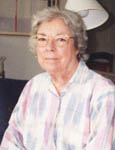
JAN SHOTWELL
artwork
audio 
- Growing up (45 sec. | 308KB): listen | read
- Jan's Gallery (45 sec. | 309KB): listen | read
- Artwork (58 sec. | 397KB): listen | read
- Process (33 sec. | 227KB): listen | read
- Teachers (45 sec. | 311KB): listen | read
- Advice (17 sec. | 116KB): listen | read
audio text
Growing up
I spent a fair amount of time in the principal's office for drawing horses on my arithmetic papers. I drew horses on everything, practically. And of course, it never occurred to anyone that this was significant. So, I just got scolded a lot. The only art we had in third grade was the real mundane, non-creative, making the clay tiles and everything was a project. There was no individual creativity allowed. Then I didn't have art in school again until I was in high school, and that was very, very thin. But I remember any time I could find paper and crayons, I was drawing something. My dream was to have a great big box of crayolas.
Jan's Gallery
Drake University kept saying, "Why don't you open a gallery? Why don't you open a gallery?" I kept saying, "I don't want to open a gallery!" And they kept saying, "Nobody can do it but you." So, I went out and found this little kind of a cubbyhole on Maple Street. I had a stable of local people—sculptors, young artists—who were delighted to have a wall to hang the art on, and I was delighted to have them. I gave any number of artists their first shows in Des Moines, some of whom have gone on to be pretty well known. So, that was the best part—letting my intuition tell me here's one that I want to watch for, and have them in five years or six years or whatever develop into established artists. But there was no place else in town for young artists to get any exposure.
Artwork
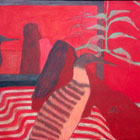
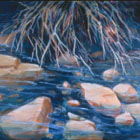
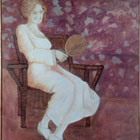
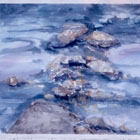
I always seem to go back to the landscape, because I love the way Iowa looks. I do like the water and the way the land looks, abstracted a little bit, I don't like to copy. I did a whole series for several years of Family Album, which was from my father's and my mother's albums—many of those people I have no idea who they are or were. And that was, I think, when I really got into acrylic and mixed media, because I found that I could draw and use fixative and go back in with acrylic, and it was a combination of drawing and painting. I did those for a long time, and just had a wonderful time, because they turned out to be so funny sometimes. Then I went back to landscape for awhile. When I've seen paintings of mine that I did a number of years ago.... I'm fond of saying that generally the reaction is one of two things. It's either, "How did I do that?" or "Why did I do that?"
Process
Process has always been more important than product. I always thought if the process was right, the product would be. I don't anticipate that my body of work will have made any significant dent in the world of art. But if people who have bought my paintings have them and enjoy them, then that's the most I can expect. I have given a lot of paintings away. Well, ended up giving about fourteen to the homeless shelter and to Hawthorn Hill where they seem to be enjoying them. I would rather have them on somebody's wall than have them sitting in a dark storage room.
Teachers
Bob Freimark was the person who loosened me up and let me not be afraid of the paint or be timid about what I was painting. He used to come around and say, "Don't think it to death, just paint it." Fred Gros, of course, was the instructor who, philosophically I think, had the most impact. He said wonderful things, like at the beginning of a drawing class, he'd say, "You'll notice we have very large trash bins. Don't be afraid to use them." And he would also draw with us in the class, so it was never an I'm-the-teacher-you're-the-student kind of relationship. It was we're-all-in-this-together. He also said, "The success or failure of a work of art occurs in the studio. Everything that happens to it after it leaves the studio becomes a sociological event having little to do with art."
Advice
First, learn the skills. Learn a little basic drawing. Learn to use the tools you're going to need, and then just dive in and do it. You learn more from your failures than you do from your successes, I think. You don't learn from reading books or watching somebody else. You learn by doing it.