
NAOMI KARK SCHEDL
artwork
audio 
(see also Making Art in Iowa)
- Parents (46 sec. | 315KB): listen | read
- South Africa (46 sec. | 318KB): listen | read
- College (59 sec. | 407KB): listen | read
- Teaching (44 sec. | 302KB): listen | read
- Artwork (65 sec. | 443KB): listen | read
- Advice (54 sec. | 368KB): listen | read
artist statement
2005
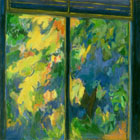
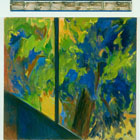
I became interested in playing with light and shade when I painted Outside: the Woodland. I used yellows and other warm tones against blues to create both tension and the play of sunlight on trunks and leafy forms. I used the latter to create movement as well as diagonal lines which I repeat in the dark window shade. The color and vertical line of the wall gives a sense of space to the rather flat background. I painted Encroaching the Woodland in a similar manner by using a variety of warm and cool tones. I over-emphasized the diagonal of the window to dramatize the probable cutting down of the trees when the area was turned into a housing development as seen in the small photograph above the painting.
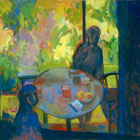
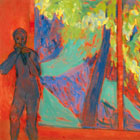
In the Screen Porch, I wanted to contrast the sun shining on the lush colorful garden against the shadows on the porch and the still darker interior. The shadowed figures and round table repeat some of the exterior forms. The abstract vertical and horizontal lines are stabilizing elements. Summer Music celebrates summertime through its lively brushwork of blue, aqua, yellow and orange tones on the strong red which becomes both background and foreground. The blue musician repeats the cool colors of the woodland and vertical forms.
audio text
Parents
I was born in Capetown, South Africa, in 1920. I think my mother came there when she was a very young child. My father was somewhat older and I think he arrived in 1880. He was a physician and she was a woman who was very interested in women's issues. She was a painter, an artist, and a writer. My father was very interested in the world at large. He wanted me to be a doctor. And I thought he worked too hard, and I decided to become an artist, and then I discovered you work hard as an artist, anyway!
South Africa
The Malays were brought over to South Africa by the Dutch East India Company from Indonesia, so essentially they're Indonesians, and remained Mohammedans. They painted their houses in brilliant colors—purples and mauves and oranges and so on—and so I remember all that color. I think that really made an impression on me, because when I came to the United States and I started painting, my nostalgia took the form of painting Malay funerals, Malay weddings, Malay flower sellers, the Malays washing clothes in the rivers. So that became something I did when I was in school.
College
I was going to go to Radcliffe. And then when I got there, I discovered, (a) it was a women's school and I didn't want to go to a women's school, and (b) that I couldn't really do art in the sense of practicing art, I would have to do art history. And I'd already decided that even though I liked art history, I didn't want to be an art historian. So I went around looking at schools, and I discovered Yale.
I discovered I was in a man's world. I wanted to take Ralph Linton, who was an anthropologist. I wanted to take some of his courses, but I wasn't allowed to because it was given in Yale College, and that was a men's school. We women also sat in the back of the lecture classes. And one of my friends was slightly deaf, and she asked the dean if she could sit in the front, and he said no, it was against the traditions of Yale.
Teaching
I was a part-time instructor because I felt that I wanted time to do my own artwork—by that time I was ready to work on my own. The 1960s and '70s was a time of the feminist movement. It was also a time of a sort of a renaissance in the fiber arts. So I invited internationally-known artists in fiber art to come and give fiber workshops during the summer, and they became very, very successful. I felt that I needed some more experienced people to kind of give some excitement to my students.
Artwork
In my own work, when I decided to do the cradles, that really was part of the feminist movement, because I was using a form that was considered a craft, a Native American craft, and I wanted to use it to make an art statement. I wanted to say the American cradles are beautiful things. I'm going to use my cradle to make a statement that a cradle can be many things.
Those first cradles and carrying blankets then changed. I started turning the cradles into cradle/caskets. And so, what originally were sort of made out of paper rush, became kind of blackened. The interiors looked as though they had been burnt. And it really was a statement about war and destruction, and also the life-death process
Advice
It's very difficult for young artists to get jobs now, unless you want to go into computer art. And also, you have to keep on working to eventually make a statement. I mean, it's got to be consistent. And if you have a job which is not in art, you have to be a very strong person to keep on working. And I think the discipline of time that you have to put into it in order to eventually become good—because it takes a long time to become a good artist—is very difficult. So I think you have to be a very strong disciplined person with a great deal of desire to be an artist to be successful.