
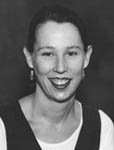
KRISTIN QUINN
artwork
audio 
(see also Making Art in Iowa)
- Art classes (40 sec. | 273KB): listen | read
- Grad school (59 sec. | 407KB): listen | read
- Artwork (54 sec. | 370KB): listen | read
- Natural world (51 sec. | 348KB): listen | read
- Painting (37 sec. | 255KB): listen | read
- Art is exciting (57 sec. | 389KB): listen | read
artist statement
(1999)
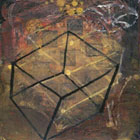
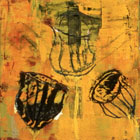
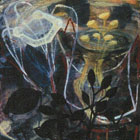
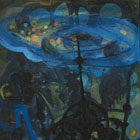
These paintings pose simple questions: How do clouds form; how does rain fall; what is the architecture of a bird wing, of plants, or snow; what color is pollen; how can wind be painted; what does light look like through amber?
Each painting is developed in layers, like strata of earth or skin on a body. Various tensions—form and non-form, fragility and mass, decay and growth, the organic and the inorganic—give each a sense of wholeness. Assembled together, the paintings map both visible and invisible aspects of landscape and serve as guides to a visual, natural history.
audio text
Art classes
I always loved drawing. Drawing and painting, sculpting, making things. There was always an afternoon art class I was in from as far back as I can remember.
High school art was pretty abysmal, really. I think I spent two years of my advanced art class painting a mural of a bulldog and a basketball player. But in junior high, I was actually still going to the Corcoran Museum School, and I did figure drawing in junior high, and that was real exciting. That was a wonderful place to be—to go to a museum with incredible collections and make art there, really set the course—like this is really what I want to do.
Grad school
My sister is here and she teaches at Augustana, and I'd just got out of undergraduate school, and she said, "Come out and help me renovate a house." She is a potter, and we did a lot of collaborative work together. Eventually I realized I really needed to get around painters. So I went to Indiana University in Bloomington just to study painting. That was a really fantastic program, and it has some wonderful people teaching there. But I had this complete crisis, and stopped painting in graduate school. I found myself avoiding my studio by going fossil hunting. Something about the research, then the digging and the excavating, translated into my work, you know, and I started working smaller. The symbolism started to come in from the pottery experience. It was a really wonderful time. Gut-wrenching, you know, as graduate school should be, but I really, really admired the fellow painters there.
Artwork
I think about it like a landscape. But if you looked at them, you'd say, "But I don't see any horizon line." I don't think anything in it is really abstract, because when I put down a color, it's something—it's pollen, or it's tar, or it's sky—night sky color—or it's plastic flower color. So it's never abstract. Occasionally, when I start a painting, there is less conscious thought. But as I proceed in the painting, they're always things—so I think they're very representative. Sometimes they're called organic abstractions. But really, the way I think about them is, well, they're kind of landscapes. Not to be misleading—they're not linear spaces. They're very layered, almost like a collage space. Sometimes I describe them as like a puppet theater with all the shims down. It's real confusing space!
Natural world
Being in this studio, which is in an industrial section of our area, you know, driving past the Case plant everyday, driving past Midland Steel, driving past even the cruise boats, the gambling boats, and the signage. There's something about the collision of that, that I'm dealing with. I really want to deal with that as part of the natural world. There is something about that sort of synchronism of the way you experience nature, never really being able to get to nature without stepping on a gum wrapper that I'm dealing with that I wasn't really dealing with last year in the work. I think that was more about the "natural," quote, you know, flowers, bugs, plants, air, wind, storms. But now, I think there is something more unnatural coming into the work, which I'm excited about.
Painting
I suppose the research is ongoing, and as I'm driving, it's just like a fossil hunter, scavenging. I just store them, or take pictures, or draw them. But I don't think about them when I start a painting. At that point it's more formal. And then, they start to mature; forms start to occur. But things assemble and disassemble, assemble/disassemble for months before they're done. You know, I don't stop until it's really taught me something—until it's sort of come up with a new system, or a new way of seeing, or something that's kind of an "aha" or it has really taken me to a different place.
Art is exciting
The process is surely exciting, and sometimes it is like something else is happening. But usually, it's very, very physical, very conscious, very confrontational, real active. Occasionally, a painting will paint itself—now, I say that because sometimes it's like once a year, a painting will paint itself. Sometimes, it's like, I don't know how it happened. But usually, it's just a lot of hard work.
It's the most exciting thing you can do—to make art. It's the hardest and it's the most exciting thing. Just trust it. I am hopefully very enthusiastic about art-making, and at the same time, I'm not just a cheerleader. It's a very important career—especially at this time. It's the most honest way to wrestle with ideas. Visual arts, and literary arts, and performing arts—I think it's about as exciting as it gets.