
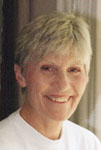
MARY MULLER
artwork | audio | statement | 2008 update
artwork
audio 
(see also Making Art in Iowa and Art & Spirituality)
- Child art (56 sec. | 384KB): listen | read
- Art 101 (39 sec. | 265KB): listen | read
- Lessons (76 sec. | 519KB): listen | read
- Artwork (38 sec. | 260KB): listen | read
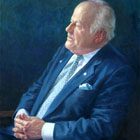
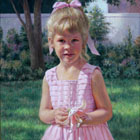
- Portraits (51 sec. | 352KB): listen | read
- Art and living (48 sec. | 327KB): listen | read
artist statement
For over one hundred years, the world has been reeling with changes; with psychological, progressive, dreadful and catastrophic changes. I sense a need for a stabilizing influence or balance from which, no doubt, will grow new directions for the artist. I do not feel that ugliness, despair or shock are necessary criteria for art, although they seem to create a lot of excitement in the world of those who determine what art is.
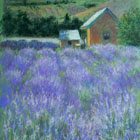
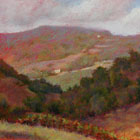
Nature, architecture and the human face all present aspects of balance to me—the familiar perhaps—but still very exciting. This is what I know best. New observations enlarge the proportion of the sky (with its ever-changing patterns) to the earth. They also squeeze it at the top of the composition to give the terrain a turn with its natural perspective journeying from the front to the back of the painting.
A change of medium and subject matter is stimulating even, necessary for me. Landscape provides a welcome change from portrait work. The human likeness, the most difficult subject matter to capture, is nothing without a feeling of the character of the model and the artist’s love for people. I personally want my subjects to breathe from the canvas. I want their presence to be felt.
My discovery of late involves the merit of a bright, warm ground beneath the pastel chalks and oils. This causes a challenge to the relationships of color. I create problems and my vision finds its expression through their solutions. I am constantly finding new ways of looking at subjects and perceiving things I have never noticed before.
I feel the artist helps others to see differently. I hope this is a result of my work because I have been given so many incredible views.
2008 update
My artwork has not changed dramatically in the past ten years, with the exception of there being a steady list of portrait commissions.
I have to work very hard to find time to paint my landscapes and florals. My teaching takes up a great deal of time. Teaching art lessons at the Iowa Correctional Facility for Women in Mitchellville, which I started in 2004, has turned out to be a huge investment of time. We frequently have exhibits of their work.
The biggest change in my life has been the hiring of an assistant.
I have one who does anything I ask her to, including emptying the dishwasher, keeping my financial records, running errands, etc. She, however, is filling a large portion of her employment photographing and matting prison art work, and I am now looking for an answer to freeing her up to do my work. In exchange for their art lessons, I have a student who does my photo filing, one who schedules our models for portrait classes, one who stretches my canvases, builds partitions to block out light, shovels snow—whatever—and students may model for classes to help pay for their tuition.
My Artist's Statement includes changes in approach to my painting, especially the use of red backgrounds for my landscapes and florals. The portraits continue to be an adventure, because each subject is different from all others I have painted.
Attendance at the Art of the Portrait Conference for the Portrait Society of America has been an annual addition to my calendar because of the opportunities and information regarding portraiture presented there, both painting techniques and the business of portraiture.
In addition to many family and business portraits, I have also been privileged to paint portraits for Iowa State University's Agricultural Dept., the Law School at Drake University, Lt. Gov. Sally Pederson for the Governor's office at the end of her administration, and several for Planned Parenthood.
The computer and digital camera have completely changed my approach to my business and my organization of it. They have also facilitated the use of teaching aids for my classes.
Five or six years ago I began having gardens built in my yard for plants and flowers to paint and have available for my students to paint. I added a four-season porch for a new studio. My classes had taken over my space, and I needed to have my own.
What motivates me to paint?
I have always painted because I enjoy it, but I at one time thought I could have set it all aside for playing bridge, tennis and bowling. But not anymore. I have reached a place where I just have to paint, and I find as much pleasure in watching students grow as in creating my own images.
audio text
Child art
[My mother] is really the reason I'm an artist, because when I was a little girl, every time I would draw or color something I would take it to her, and she'd tell me how beautiful it was. And then she always gave me something to work on, so I knew that I could always grow.
When I was in the first grade, a painter came to our school—she was a finger painter—and she did a painting of a forest scene with little animals and birds and flowers and things. And she did it all in finger paint, and many colors. The whole school just sat there on the floor and watched her paint this picture. And I can still remember the butterflies in my stomach. I wanted to do that so badly. I remember going back to my class and asking Miss Meston if we could do finger painting. So, she got finger-painting supplies, and we were allowed to have yellow, red, or blue. We couldn't have yellow, red, and blue—just yellow, red, or blue. I was so disappointed. I was absolutely frustrated. There was no way I was going to get to that painting that I had seen in the auditorium.
Art 101
I could have gone into P.E. because I loved it. But I ended up in the art. And I remember as a freshman that I was allowed to take Art 101 because I was an art major. I was taught the relationships of things to each other on the plane, and what happens when light hits objects, and suddenly the whole world opened up. For the first time, I was looking at things in a completely different way, and I could see paintings everywhere I went. I remember my first trip home—after I took that course—in the car, and I could see the paintings. I could see the form in the trees, and things that I didn't know existed before. And I grew very quickly after that.
Lessons
I got married a year after I got out of college. We had five children in six-and-a-half years. I didn't give much thought to the art at all until the youngest one was in school. So then, I asked if I could take art lessons, and he said we couldn't afford it. So, I somehow found enough portrait business in just charcoal portrait drawings to pay for my art lessons. I started taking art lessons with Dimitar Krustev. He decided that he wanted to take a group of painters down to Mexico to paint for a week. And I wanted to do this very much, okay? And I knew my husband would say no—by this time I'd learned that. So, I did one picture of one of the models, and I put a price of $200 on it, and the lady who ran the beauty parlor bought the drawing.
My mother and father-in-law were sitting at the table, and the children and my husband—I said, "I've decided I am going to go to Mexico to an art workshop in August." And he choked on something, and my father-in-law said, "Well, that's wonderful." And after my husband recovered, he said, "Well, where are you going?" I had no problem with support from him after that. The minute I claimed my own freedom, I wasn't oppressed. And I think that was one of the most important things for me to learn.
Artwork
I'm representational. I'm excited about the way light affects color when it hits the form. The composition is really important. And I like the strong value contrasts, which create the design. And I don't need to go beyond this and create something that I have to make up, because I'm so excited about what I see. It's taken me a long time to realize that's okay. That doesn't mean I do exactly what I see. I can change things to make the composition work better or to develop a part of the painting to be more important than another part. But the beauty of nature to me is so exciting, I don't know if I'll ever get to that other part.
Portraits
The concept of painting from a photograph is somewhat limiting. I take the photograph of the person, but I'll take one or two rolls, different positions. Then I pick the position I like. If I have a person that maybe it's a posthumous portrait, if it's an adult, to have a younger picture—maybe he's 70—have one when he turned 50, and another one when he was 30 or 40, one when he got out of college. I like to see the shapes of the whites of the eyes. I mean, how can you make that eye look like them if you don't know what the shapes look like?
And when you get enough information, then you can look at this photograph, and having done so many live people, you can read it. If you've never done live people, then it's difficult, I think, to interpret a photograph into a person. But when I do a portrait, I like to sketch the person, because I can see their face moving. Then when I look at that photograph, I have a memory of that face moving, and so it's not just a static thing.
Art and living
I think each one of us has certain qualities of expression, certain things that we're good at or that we enjoy doing. And I think that I found it early for me was a most fortunate thing. So many people don't find the thing that they're good at or the thing that they enjoy doing unless on a hobby level. Many people are stuck in jobs that they don't enjoy all their life for the sense of security, or just to make a living. And for me to do the thing that I most enjoy doing to make a living, I think is just an incredible opportunity. It still touches on the qualities of balance, beauty, peace, harmony. All of those go into a painting, and all of us want that in our living, and I don't know that there's much difference between art and living. I think they're about the same thing.