
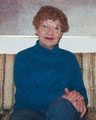
ELIZABETH MILLER
artwork | audio | 2008 update | galleries | first-person narrative
artwork
audio 
- Drawing (32 sec. | 221KB): listen | read
- Art as calling (32 sec. | 222KB): listen | read
- Landscape (55 sec. | 375KB): listen | read
- Watercolor & oil (33 sec. | 224KB): listen | read
- Advice (30 sec. | 206KB): listen | read
2008 update
The main thing that has changed in my life is that my husband and I moved into a townhouse at a retirement community two-and-a-half years ago. I have a studio in the lower level and continue to paint.
I had a solo exhibit in November and December 2007 at Arte Gallery, located in the East Village. I still have work in the Corner House Gallery in Cedar Rapids.
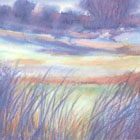
My work has not changed. I still paint mostly landscapes and flower gardens.
audio text
Drawing
I loved drawing. I started drawing when I was just a tiny child. At family reunions all my cousins say they remember I would sit around drawing and making portraits of people. And that was my favorite thing to do. I think my family thought I was wasting time and off to myself, you know, and not involved. But when I was in junior high, I was going to Saturday art classes at the University—there was sort of a scholarship program. And so that kind of satisfied my need to draw, and encouraged my parents to let me draw and do what I wanted to do with drawing.
Art as calling
In high school, I was president of the Y Teens, and went to the convention in Omaha the summer before my senior year, and Katie Faulkner was a professor, our painting teacher at the University of Nebraska, and she was a speaker there. And that was just about the most awesome thing—what happened to me just to hear her talk. And she talked about art as if art is a calling, that you really—you have a calling, and there's nothing else you can do about it. You have to do it. And I think I sort of always have lived that.
Landscape
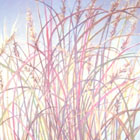
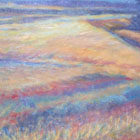
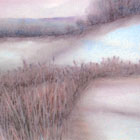
I have really kind of limited the work I do the last, say, twenty years to landscape. Because I started becoming very, very interested in the natural landscape. I did a Faculty Improvement Leave to visit natural landscapes all over the state and did a lot of research, studying the prairies and the natural formations of the rocks and the rivers and everything, and spent a year doing that. And from that point on, I have really kind of limited everything I do to sort of natural landscapes. It's a great desire. It probably is boring to other people, to have me keep painting the prairies and things like that over and over and over again. But that's what I'm interested in.
Watercolor & oil
I think watercolor is a lot harder than oil. But I get pleasure out of doing both, because watercolor is such a surprise. You never know what you're going to get until you start working it. And it starts telling you what it wants to do. Oil you can control just a bit more, keep building up, changing your mind. They just do such different things—it's like just two different experiences. I continue to do both. Watercolor, I just keep wanting to get better! I just keep trying to conquer it.
Advice
Don't even think about it unless you just want to do it more than anything else. There's too much work involved in it, if you're really going to pursue it, too many heartbreaks if you can't take it, and you have to do it in spite of that. And just keep trying to constantly be developing. It's not an easy life, if you think of ease as being accepted and making money, things like that, because it just takes a long, long time before you make any money from it at all.
first-person narrative
Native Prairies and Gentle Hills
edited from interview | copyright © 2003–2026 Jane Robinette | All Rights Reserved
I never have been totally sure of myself about anything I've done in art. I always want my work to be better. But, I've had other people say things that make me think, "Well, compared to others, maybe I'm all right." I just knew I wanted to do something with art, I had no idea what. There weren't very many art jobs around. It was like being a dreamer but not having a dream in mind—not really knowing what the dream was.
*
I was always kind of independent. I was not a bad child, but I wanted to do things my own way. My childhood was kind of like "The Waltons." My grandmother had had a leg amputated when she was in her fifties, and moved in with my parents—and my grandfather, too. She was always baking pies and baking bread. When my mother was busy with church things, there was always somebody there, because my grandparents were there to spend the time with us. I was a happy girl. My parents were lovely people, and it was a close family.
I loved drawing. I started drawing when I was just a tiny child. At family reunions all my cousins say they remember I would sit around drawing and making portraits of people. That really was my favorite thing to do. I think my family thought I was wasting time and off to myself and not involved. They never really quite understood my being an artist. So there was always a division there, from the time I was a little kid.
In Lincoln, there was an art program where the person in charge of all the visual arts in the schools would come out about every two weeks and give a little art appreciation session. I remember week after week after week it was usually always a Grant Wood print that she would show us and talk about. I always thought of Grant Wood as the only artist there was, because I really didn't know about many other artists. My family wasn't interested in art, so there was no art education going on there. When I was in junior high, I was going to Saturday art classes at the University—there was sort of a scholarship program. I and several of my friends were chosen to go. The classes were right across the hall from the galleries, and we would go through the galleries constantly, and they would give us talks about new pictures or a new exhibit. That satisfied my need to draw, and encouraged my parents to let me draw and do what I wanted to do with drawing. So that started my art education.
I did all kinds of art, but I loved to do portraits. I could do fast caricature-like portraits, and then more serious ones. I have still sketchbooks with portraits of children. When I babysat for people I would sketch the kids.
My parents did become supportive later. When the National Endowment for the Arts started, I was invited to be on the first Arts Council by Governor Hughes, and then reappointed by Governor Ray. I think they thought I'd finally made it when that happened.
*
A great-aunt was quite a successful painter; sold lots of work. And of course, in my family to sell means that you're successful! She did landscapes and beautiful birch trees and things like that along Lake Michigan. I always had a feeling that if she could do it, I could do it, also. I was president of the Y Teens—the YWCA's high school organization—and went to the convention in Omaha the summer before my senior year. Katie Faulkner was the painting teacher at the University of Nebraska, and she was a speaker there. That was just about the most awesome thing that had ever happened to me, just to hear her talk. To hear her talk about art as if art is a calling—that you really have a calling, and there's nothing else you can do about it; you have to do it. I think I always have lived that.
*
I enrolled at the University of Nebraska against my parents' wishes. They wanted me to go to Nebraska Wesleyan. But I wanted to go to the University because I'd heard of the teachers, and I'd been there for my Saturday classes. They called it Advertising Art then; I thought I could make a living doing illustrations of some kind. I started that for the first two years. Then later switched to painting and drawing and printmaking. Painting and printmaking was my major.
Katie Faulkner got me started. She gave me real fundamental knowledge: anatomy, perspective, sound fundamentals of the techniques of the media. Everybody who had gone to school there and had had her for a teacher thought of her as one of their guides. But then she left. The University had some problems with a new group of teachers coming in and the old teachers leaving. A new bunch of teachers came in, and one was a young man who had just gotten his master's degree, called Rudy Pozzatti, and he was a printmaking and painting teacher. I took printmaking and painting from him, and I would say he was an inspiration. He was very productive; he worked on his art all the time. He was very concerned about his students.
*
That summer after I graduated, I got a letter from Dwight Kirsch, who was the director of the Des Moines Art Center, and he asked if I wanted a job in Des Moines. I knew him as a student at Nebraska. Joe Ishikawa, who was the assistant curator at Nebraska, had also been hired to come over to Des Moines to be the curator at the Art Center, and he might have put my name in or something like that. I didn't apply. I have never applied for a job in my life. I had no idea I would ever be hired.
I should say that my freshman year at the University, my art history teacher announced that he had just come back from Des Moines at the opening of the Des Moines Art Center. He had newspaper clippings, and talked about it practically the whole class period—how wonderful the Des Moines Art Center was, what a good art collection they had. And I always, at that point on, thought that Des Moines was just like a heaven for art, with no idea whatsoever that I would ever be coming to Des Moines. But always just thought of it as a mecca for the artist and art. Then the year that I was asked to come to Des Moines, it was just wonderful. I thought, that was just meant to be!
I was a gallery assistant; I did a little of everything. I worked there two years, then I was invited to go to Waterloo and be the head of their gallery and their little art program. After a year and a half, decided it didn't fit what I wanted. I really missed the Art Center, so I came back to Des Moines and was the educational coordinator. I had been teaching a night class; Leonard Good, who was the head of Drake Art Department, I guess overheard me teaching. He liked the way I taught, and so after a year and a half, he invited me to go to Drake to teach.
I first went over and taught a night class for them—while I was still working at the Art Center—in 1955. Then in '56, I started teaching full-time at Drake. I taught there for about three years full-time, and then I met my husband Vern, who was in the music faculty. Drake had a rule then that husbands and wives couldn't teach in the same college, so I became part-time. I taught in their evening class program, the University College, after that for altogether thirteen years.
The year after I got my master's degree, I had a call from the head of the Art Department at Iowa State, who asked if I would come up and talk to him about taking a job up there, so I did do that. I went to Iowa State to teach painting and drawing.
*
When my oldest daughter was in a crib, I would paint and she would watch me—she thought I was entertaining her! She was at my side, so she was happy. I remember printing some silkscreen Christmas cards at a little table next to her playpen. Silkscreen ink is rather permanent. And she was about ten months old. The phone rang and I went to the phone and when I came back, she had silkscreen ink all over her—in her hair, in her eyelashes, and her clothes and everything. It was just horrible! I just knew she was going to die from that—I had to use turpentine to get it off. It was kind of scary to put turpentine on her. But she thought that was real fun, getting in all that stuff! I never knew that taking care of babies would be so time-consuming! I loved having children. And they're still just great. I enjoy their company very, very much.
*
I have really limited the work I do the last, say, twenty years to landscape. At Iowa State, I got to know people from Landscape Architecture. I learned a lot about prairies and about the native trees, and all sorts of things like that, being influenced by those wonderful professors. In 1981, I had a Faculty Improvement Leave to visit natural landscapes all over the state to make studies for a series of paintings. I did a lot of research, studying the prairies and the natural formations of the rocks and the rivers, and everything. I spent a year doing that. And from that point on, I've mainly been painting the natural landscapes. It's just a great desire. It probably is boring to other people to have me keep painting prairies and landscapes over and over again. But that's what I'm interested in. I also love painting gardens and flowers.
I think the Iowa landscape is just fantastic. It's wonderful. Iowa has so much variety in the landscape. I travel and I've done paintings from France and England and Italy and Greece, Ireland and Hawaii. And I always am glad to get back to Iowa. I love the mountains. But the mountains are just a bit grandiose, and I rather like the gentle hills in Iowa for painting. I like to go to the mountains and spend time there, but I really am not too interested in painting there.
I use oil and watercolor both. I go back and forth. I get pleasure out of doing both. I've used acrylics; didn't like them very much. I've experimented with several other kinds of synthetic oils. But I've gone back to just plain old oil the last few years. I think watercolor is a lot harder than oil, because watercolor is such a surprise. You never know what you're going to get until you start working it. And it starts telling you what it wants to do. With oil you can control just a bit more, and keep building up, changing your mind. They do such different things—it's just two different experiences. I continue to do both. With watercolor, I keep wanting to get better at it! I just keep trying to conquer it.
I've really always liked to experiment and explore and try to learn about different mediums. I was one of the assistants on the fresco at the Des Moines Art Center, and I enjoyed learning everything I could about frescoes, and even did a small fresco of my own at home. I've liked to explore egg tempera and casein. I've used lots of different media just to learn about it.
*
I always hope that my paintings will give somebody pleasure. I'm not thinking of that as I'm doing them, but I hope they will give some people pleasure. And I think they have. I hope that the paintings will have the essence of what I saw. I don't try to paint things just as I see them. They might appear rather realistic, but they're not always the way I saw them. I hope people will appreciate nature more—wanting to look at nature in a different way, or just appreciating that hill and that tree and the plants.
I really have to go out and see something first. I've made up a few pictures, and I've done some things from memory, but mostly I really have to go out and look to get ideas. That doesn't mean what I see out there is going to end up exactly the same, but I start out that way—making sketches. I do some photographs, so that I have some close-ups of the grasses or plants. And then sometimes I work from that sketch almost exactly; sometimes I work from two or three sketches and put them together. I don't work fast in watercolor, so watercolors aren't really great for me to do when I go out sketching because I have to stay in the same spot for a couple of hours. I'd rather be moving around, and getting more sketches. But then I start doing a watercolor, sometimes a real small watercolor first, and then I go to a bigger watercolor. Sometimes I go directly to the bigger watercolor. If I really like that and think there's possibilities there, I do it in oil on canvas, quite often very large canvas.
I usually have five or six things going at a time. After I work awhile on a painting, I lay it aside to get away from it. Then I go on to another work. I have to put a work away for awhile to be more objective about it. I get creative blocks, but there's always something to do, like framing, matting, and cleaning my studio. Just being in my studio. I usually keep working at something, even if it's awful. Just to be doing something. Sometimes I get out an old painting and work on it, or paint over a watercolor with oil—anything, just to keep my hand in it.
*
I usually go to my studio at least three or four days a week. And maybe four hours on those days. It changes. Like in the winter, when I have more time than summer, it could be as much as twenty hours a week.
I have the whole back half of the basement. I have a big table; I have two easels. I have good light, even though it's the basement; I have two long fluorescent tubes that have some warm color in it and some cool color. I listen to the radio most of the time. Listen to NPR.
When I had an apartment by myself, I painted with the canvas leaning against my bed, and I sat on the floor. Then I had an apartment that had a little apartment-sized stove that had a lid that came down, and I'd put the canvas against the wall, and my paints there. But ever since I've lived in a house, I've had a place to work. That's very important. And I like it in my home, rather than a studio away from home, because I integrate it with my daily life. That can be a distraction at times, but it also can be a great big help, because I can run to the studio and work for an hour, and then do something else—instead of making a big deal about traveling to a studio downtown or something.
*
Being an artist gives me the opportunity to enjoy being by myself so I can do my artwork. I always have something to do, being an artist. I've never been bored. I do think of making art as work. It is not fun. But it is mostly enjoyable work, sometimes agonizing.
Don't even think about being an artist unless you just want to do it more than anything else. There's just too much work involved in it, if you're really going to pursue it—too many heartbreaks if you can't take it, and you have to do it in spite of that. It's not an easy life, if you think of ease as being accepted and making money, things like that, because it takes a long, long time before you make any money from it at all. Always keep trying to develop whatever you're doing, and whatever way you're doing it.
I think the process is most satisfying—it's scary, the process is scary. It's just interesting to see what's going to happen. You never know what's going to happen when you're painting! Or something comes to you to do that you just had no idea was going to pop up in your mind. The final framing of something is kind of enjoyable, too. When it's finally finished and you're ready to frame it, there is satisfaction. And once I'm finished, I'm finished. I really don't care about them that much for the most part.
I just feel the urge to paint. And if I don't paint for a week or so or when we travel a lot—by the time I get back, I just feel awful that I haven't painted. It's just something in me that wants to do the work all the time. It's not to have finished works; it's not to have a show—that's not the reason. It's just that that's how I want to spend my time.