
EMILY MARTIN
artwork | audio | statement | galleries
artwork
audio 
(see also Making Art in Iowa)
- Parents (54 sec. | 368KB): listen | read
- Art class (40 sec. | 274KB): listen | read
- Children (60 sec. | 406KB): listen | read
- Creativity (57 sec. | 394KB): listen | read
- Open process (30 sec. | 206KB): listen | read
- Advice (46 sec. | 318KB): listen | read
artist statement
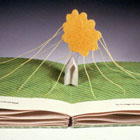
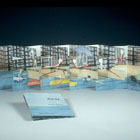
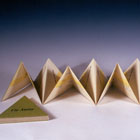
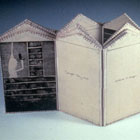
I have always combined the narrative with the visual. I trained as a painter then began to expand the narratives into other media. First prints, then house sculpture and now also sculptural and traditionally bound books. I have been making artist's books since the early 1980's, since 1988 I have moved back and forth from paintings to sculpture to books within the same body of work.
audio text
Parents
I think the most important thing I learned from my mom was that if you really wanted to do something, you could. And that if you didn't do something that you really wanted, you couldn't make excuses. It's not something she ever verbalized. But she didn't tolerate whining. I don't think she had any real desire for us to be certain things like a doctor or something like that. She wanted us to do what we wanted to do. And so, she just would kind of push us to try and figure out what that was.
My dad, I think, is a classic engineer. He's very methodical to the point of rigidity—and he's mellowed tremendously. But I think that what I got from him was that sort of methodical approach to working—that you figure out what it is you want to do, and how you're going to get there, and planning ahead, and tools and all of that kind of stuff.
Art class
My mother talked me into a couple of art classes that were actually for adults, because there weren't any for kids my age when I was in seventh, eighth, and ninth grade. The high school kids could take adult art classes, and the grade school kids had lots of recreational ones, but there was this sort of dead zone. And she talked the teachers into taking me, basically. It was a little peculiar because everybody was so much older than me, but not unkind. You know, I think they gave me a chance to show that I wasn't going to be obnoxious. It was a ceramics class. We got to do wheel-throwing and sculpture and all sorts of things that I hadn't really had a chance to do much of, and it was really good.
Children
I got married right after graduate school, and I had a nice studio—it was a second garage that had been set up as a carpenter's workshop. And I spent a lot of time in the studio, which was really nice. And then I got a job.
When my oldest daughter was born, I gave up my job then and divided my time between Colleen and my studio. I really lucked out, in that when she was really little, I just took her into the studio and she slept most of the time. When she got older and was more alert, I asked this woman who lived around the corner—and I've always thought later that she didn't really baby-sit, but she was sort of taken with the idea of it by being asked. And she was an older woman who was widowed. She was perfect. The other truly amazing thing was that she charged me a dollar an hour! And after Tess was born, she took both of them. So those early years, which can be really hard, I had Helen and she sort of saved the whole situation.
Creativity
Even though it's really frustrating when you can't work, sometimes it's equally frustrating when you are working and it's not going right. It's not smooth sailing all the time. I think what happens in the studio is that you set up a situation where you can work on your ideas, but a lot of it is just that—it's really hard work. You don't sit around waiting for inspiration to strike you. I mean, if you did, you'd get very little done. I think it's Woody Allen that says ninety percent of creativity is showing up. By setting up my life so that I'm in the studio a lot, I just am in the position of bringing out or focusing the ideas that I get.
And sometimes you do need time off. You need to refresh; you need to think about things, but not work on them. Some ideas that I get aren't ready—it's a good idea, but it's not ready. And if you rush in and try and force it into something, it's just going to wreck it.
Open process
I try not to have too clear an idea of how it's going to look at the end, because you do need to put yourself in the position of accepting the accidents and things. Sometimes accidents are bad, but sometimes, you'll find something from that that's better than what you were thinking to begin with. Plus the other thing is, is if you know how it's going to end up, there's not any real interest in getting there. If you already know, then it's just a matter of sort of slogging through to the end. So I prefer to keep it open.
Advice
I would tell them not to go to an art school as an undergraduate, and to go to a liberal arts college that has a good art department so that they can get the art that they need, but also so they're forced into other areas. If you focus down immediately, you do yourself a disservice. I think that you actually need to look around you as much as you can when you're an artist, and not just be looking at art.
And then, going to graduate school is a good thing. It's oftentimes difficult—it's that trial-by-fire kind of teaching. But what it can do is give you a nice big chunk of time to concentrate on what you're doing. And if you go to a good place, your work will be a lot different when you get out than when you start, because you've had a chance to really explore.