
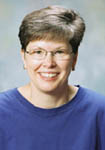
LOUISE KAMES
artwork | audio | statement | galleries
artwork
audio 
- Grade school (44 sec. | 303KB): listen | read
- Grandmother (47 sec. | 319KB): listen | read
- Balance (46 sec. | 317KB): listen | read
- Media (62 sec. | 421KB): listen | read
- Drawing (54 sec. | 371KB): listen | read
- Artwork (61 sec. | 417KB): listen | read
artist statement
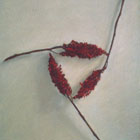
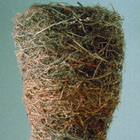
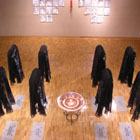
It is the ordinary in life that can carry the power or meaning of the holy. My artwork is about consecrating the commonplace. Iconic prints and drawings portray unassuming places, objects or elements from nature. At present I am not using the human figure. Instead, these ordinary objects or elements from nature can be read as metaphors for the human presence. The relationship to the human body is felt in several ways. Many images are the same size as my body or anatomical parts: a tree is the same size as my figure or a palm frond is the same size as the human heart, a series of objects relating to home are all the size of the human hand, a wooden boat is also a cradle or casket. Objects are installed in the gallery to mimic the human form creating a stronger physical connection for the viewer: a series of bird feeders (reliquaries that are symbols of home and nourishment) are installed at heart height. Drawings and prints portray objects used in the installations to create additional narratives.
read statement for Dear Mother installation
audio text
Grade school
I decided in fourth grade that I was going to be an artist, and so it was kind of like my mission. We did a lot of art projects in classes, like salt maps and other kinds of maps, and those were my favorite projects. My mom, particularly, also liked those projects, because she was the Girl Scout leader, and you know, so there was a lot of just reinforcement with that. But I remember once doing a class project that I thought I did a really great job on, and I decided I was going to be an artist and that was just sort of my identity.
I was in Catholic schools, and the sister who taught sixth grade was really an art teacher but was stuck teaching sixth grade. And so she saw a little talent and so I got to do a lot of art projects, and much of the time I didn't even participate in regular classes; I could just sit in back and make things.
Grandmother
Probably the person I had the closest relationship with is my dad's mother, my Grandmother Ellen, who has figured in a lot of my work. I spent a lot of time at my grandparents' farm when I was growing up. I always say it's a place where I could be a princess and be the only child, and so I had a great fantasy life there. I had my own bedroom and I could do whatever I wanted to and be special. And so because of that special relationship I had with them, then particularly with my grandmother after my grandfather died, when I was living away from home, if I was going to come home for a week I would stay there. And we developed an even closer relationship in her last twenty years, and then did a lot of caretaking for her until her death in 1994.
Balance
I talk about my life as having, like, three components: my community life, my academic or ministry teaching life, and my art life. How to balance the three is always an issue. For me, probably what gets caught is my artistic life, and just having time to do it. I really enjoy teaching—the personal interactions with students and the potential to change lives and to help students find meaning and just confidence in their abilities. And so I've had to come to really think of that as part of my generativity of making. I make art and I make artists, and that's part of my creative output.
Media
My primary medium is really drawing. Even though I call myself a printmaker, I spend more time drawing because it's immediate, and it's something I can just sit down and do, and much of the printmaking that I've been involved with is related to drawing.
In the last five years I've done several three-dimensional things. The first installation or 3-D project that I did was actually a piece about my grandmother and home. I made an installation of seven bird feeders, each filled with different objects related to my grandmother's home, or the idea of home. That installation really started my thinking different spatially, and then led to my most successful work which was titled Elegy for Ellen, which is four wooden ironing boards whose surface was gold-leafed and then four fabric panels hung in front of them. That was created the next year after she died, all just memorial to her work
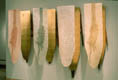
Elegy for Ellen
copyright © 1996
Louise Kames
All Rights Reserved
Drawing
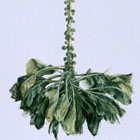
This cabbage series started when I was on sabbatical, and I was in Vermont, and it was very beautiful and green and picturesque. And there were all kinds of other artists standing in the creek painting the mill and everything. Well, none of that appealed to me. But I walked past the compost pile, and saw all these rotting cabbages, because there had been a flood, so they had to pull everything out of the garden. So there's just something, like, spectacularly beautiful about again that unfolding form and the color and the decay. So taking, again, all this refuse and transforming it—it's that intrigue that gets me to drawing. Then the immediate stage before drawing is just figuring out how to arrange it. They're pretty formal in arrangement, usually. So just figuring out how to arrange it so it transcends itself. And then the drawing is the stillness. But there's always a struggle, and sometimes the drawing's winning and sometimes you're winning.
Artwork
I would describe my artwork as the outward revelation of what's important to me, or it's very much connected to who I am or who my true self is. I mean, there's certain kind of enveloping forms that I keep drawing. There are all these leaves and there are all these shapes which enfold and conceal and reveal, and that's a lot like people. And so I don't draw the human form, but they're all about the human condition.
When I'm making things, I'm my most true self. But I also think it's a gift for others. It's a time when probably that I come closest to meditation in a traditional kind of sense—that you become just one with the object you're drawing. I guess it's a search for stillness—your search for knowing that you're part of something bigger than yourself. And then that's always balanced for me by teaching. I don't think I could ever just be a recluse and make art.