
LAURIE ELIZABETH TALBOT HALL
artwork | audio | statement | galleries
artwork
see more work in Beyond 9-11: The Art of Renewal in Iowa

audio 
(see also Beyond 9-11: The Art of Renewal in Iowa)
- Early interests (47 sec. | 327KB): listen | read
- Marriage & kids (63 sec. | 432KB): listen | read
- Artwork (56 sec. | 384KB): listen | read
- Process (59 sec. | 405KB): listen | read
- Being an artist (61 sec. | 419KB): listen | read
- Advice (28 sec. | 196KB): listen | read
artist statement
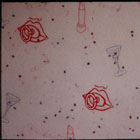
Cultural expectations of appropriate behavior are so pervasive and surround us so completely and so continually that we are typically unaware of the extent of their influence. At times we recognize specific aspects of their patterns but generally do not apprehend the enormity of their impact. In this way, socialization is not unlike wallpaper: the patterns are clear, the referents are identifiable, but the meaning and the influence of what surrounds us is often overlooked or taken for granted as benign.
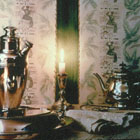
My use of wallpaper as a metaphor allows for several tiers of representation. I have made wall-height panels which can be installed as "wallpaper," "wallpaper samples" in a 28" by 40" size, and room-sized installations of wallpaper, furniture and objects. The large wallpaper prints are made using permanent acrylic inks in photographic silkscreen (with occasional additions of block printing and hand painting). Color photographs of the wallpaper in tableau exist as objects in themselves.
I have recently completed a project entitled "The First Eleven Years" which includes a series of prints three to five feet wide and eight feet in height. The content of the work positions my personal developmental history against a broader backdrop of American socialization practices. Each panel deals with personal references and with more global chronology in a consideration of events and products which shaped an emerging personality. Although the work critiques conformity-inducing socialization practices, the tone is not angry or bitter. Humor, surprise and ironic juxtaposition are employed to invite the viewer to recognize components and to make their own associations.
7/99
audio text
Early interests
I always have drawn or painted, and I can remember doing that very early on, and writing poems. I used to make books of poems and give them to people for their birthday, and they were always under-appreciated! And also, I think because of the pervasiveness of the concept in the popular culture, I became interested in psychoanalysis as a child, and I used to pretend to be Freud, and I would have my friends lie down on the couch and tell me their dreams. And I kept folded construction paper files of their dreams. So I see my interests going back a long way. But I spent a lot of time alone, too.
Marriage & kids
While I was in graduate school, I got married and had two children. I always told myself that I wouldn't marry and I wouldn't have children, so the demands of motherhood I experienced as very great. And so, I made lots of work about being controlled by the routine repetitious demands of household maintenance and childcare. And since he and I are not living together, the mood of the artwork is more upbeat.
After I finished psychology graduate school, I learned of the Women's Caucus for Art, which gave me a context outside of school to see women making art, and living art and having that be good and right, and not just a pipedream or a hobby.
Artwork
I work in a directorial mode with photography and printmaking in an effort to allow people to think about something in a different way. The subject matter is deadly serious, but I try to approach things with humor. I hope that they will see in these photographs of the installations, a reality that does and does not exist, and that can or needn't exist, and that it's possible to recognize a situation for what it is, and then to change it to something else—kind of an encouragement, like, Let's go and make one small change for the better.
Process
Usually, something happens to me, and I think about wanting to concretize it and express it. I usually look for images in the popular culture that are evidence that this is alive and out there. And then by drawing, I can distort the image or accentuate parts of it, or rework it to fit my agenda. Then I think about color—what goes with the mood of this. So then I design some kind of pattern. And I want it to resemble actual wallpaper, so that when you see it from a distance it's like, Oh, wallpaper—ho hum. And then I think about what might ordinarily go in the scene, and then what might not ordinarily go in the scene, and throw it together and try to photograph it.
Being an artist
I seem to like the process more than the product. And I really like all phases of the process. I do a lot of research. I read about things that are related and that makes connections. And I love looking for images and thinking about it in an historical context. And I love the making of it. It gives me pleasure, and it gives me challenges, and it gives me freedom to express things in ways that daily, ordinary activities don't. When I was in that heavy work phase, I was just having so much fun making the work. And I realized that I could live without doing therapy, but I can't live without making art.
Advice
I would tell her to do what she loves and to make that her priority, and let everything else fall into place. To not let fear make her decisions for her. Not to imagine that she's being realistic when actually she's being fearful or intimidated, but to identify her passion and just go for it.