
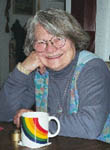
BETTY FITZSIMMONS
artwork | audio | first-person narrative
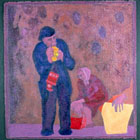
artwork
audio 
(see also Making Art in Iowa and Art & Spirituality)
- Science or art (46 sec. | 315KB): listen | read
- Being an artist (46 sec. | 316KB): listen | read
- Books (37 sec. | 252KB): listen | read
- Antarctica (51 sec. | 352KB): listen | read
- Homeless youth (53 sec. | 364KB): listen | read
- Advice (37 sec. | 254KB): listen | read
audio text
Science or art
When I was ten I was going to be Madame Curie the Second. And I had my own chemistry set in the basement, and my poor parents were having a dinner party the day that I chose to see what happened when you melted sulphur. It stunk like a rotten egg, so I sneaked out the door when I heard people complain. I probably was a handful. But I was always very busy making or doing something, and I was always the one to draw things in the classes. I liked to write, too; I was doing a lot of creative writing at that time. And then when I was fifteen, I read Irving Stone's Lust for Life. Every time in that book, like when Gauguin or Millet or any artist was mentioned, I would send for prints of theirs. So I decided that I wasn't going to be Madame Curie, I was going to be an artist.
Being an artist
It took me a long time to really understand what being an artist is all about. Initially it was just making pictures—but it's not just making pictures at all. It has to do with the total of your experience, but also has to do with exploring things that you think about that you can't explore in any other way, and trying to understand things you can't understand in any other way. At least that's what it is to me. It's trying to understand things that I just don't really understand at all, and probably never will. So I'll go on making art, trying to figure it all out. And yet it's also about color. If I have a passion in art, it's color, and then certain shapes and the way they relate to each other. And then how the spirit is expressed in different ways.
Books
When Danny was little, I started writing a book called Pirates Three; it was about a little black boy, a little white boy, and a little Oriental boy. And that's the story about how they built a ship out of crates and had a really good time, and the families got along. It was about '55 when I was doing this, which was a little bit premature trying to get anything like that sold. And I don't know to this day what really happened. It vanished from the face of the earth. The books I have now haven't vanished. I've done a lot of books. I did a book based on the Glenwood experience of working with multi-handicapped—that's where I learned what love was really all about, unconditional love, was from working with handicapped people. I like doing books.
Antarctica
Robert Falcon Scott—he was the explorer who Amundsen beat to the South Pole. He was the one who died with his men. He'd write these wonderful descriptions of the colors that you see because of light refraction and of auroras. So I did a whole series of paintings based on Antarctica. And I decided that I had to go to England. I wanted to go through all of Edward Wilson's diaries. I knew he kept copious notes on colors. He didn't have the poetic vision that Scott had as far as writing was concerned, but Wilson was the person people turned to for advice and for help. He was a very deeply spiritual man. He was an incredible man. I was lucky that I was able to do research at the Scott Polar Research Institute. And I had a table there, and did a bunch of paintings and drawings.
Homeless youth
I became very interested in this horrible, hideous, unnecessary homeless problem that we have in our country. And had gone to Buchanan House, which is part of Iowa Homeless Youth. Worked with them down there. And then they said, Well, try drop-in. Sometimes we have as many as 90 come in—just heartbreaking.
Everybody needs beauty in their lives. Everybody needs to be able to express something in their lives. One of the young women, who was 17, was found dead one morning. She was one of the young women who came over regularly to the art table who would help out. She did a collage-type thing, "All people should be treated alike." That work meant so much to her, because she was working through a lot. The kids who are homeless have been through an awful lot. Everybody has a spirit in them that needs to be touched, and it's part of our being a human being. That's something that people forget about.
Advice
One, the most important person you have to please is yourself. Don't worry whether your work looks like anybody else's—you've got to be true to yourself, to your own spirit. And two, find something that you can do so that you can eat, because you have to be able to eat in order to paint. And don't worry about so-called approval. And this thing called money is nothing but a tool anyway. All you have [to have] is enough so you can eat and keep a house over your head and be happy. A lot of people don't. And the third thing is, when you can, share what you do know. I think that's really important. Share your experience, share your work, share your knowledge.
first-person narrative
Everybody Needs Art
edited from interview | copyright © 2003–2026 Jane Robinette | All Rights Reserved
It took me a long time to really understand what being an artist is all about. I don't think I understood that until about ten or twenty years ago. I always thought it was just making pictures. But it's not just making pictures at all. It has to do with every fiber of your body. It has to do with the total of your experience, but also has to do with exploring things that you think about that you can't explore in any other way. At least that's what it is to me. It's trying to understand things that I just don't really understand at all, and probably never will. So I'll go on making art, trying to figure it all out.
I had some members of my families years ago say to me once, "Betty, why don't you just paint pictures that people like and would like to buy?" And I can't. I guess I could, but I don't want to. It's just not me. That's not why I work.
*
I always loved drawing. I was always the one to draw things in the classes. In grade school, we had reproductions of paintings. They would pass out these stickers once a week or whatever, and talk about the different artists. So even though we were way off in South Dakota, we learned about the old masters.
I spent a lot of time down along the river and hiking in the woods with friends and fishing. I was always very busy making or doing something. I thought when I was ten I was going to be Madame Curie II. I had my own chemistry set in the basement, and my poor parents were having a dinner party the day that I chose to see what happened when you melted sulfur. It stunk like a rotten egg, so I sneaked out the door when I heard people complaining! I was determined I was going to be a scientist. Then I discovered I had absolutely no aptitude for the things that one needs to have if you're going to truly be a scientist. When I was in seventh grade, I got a phone call one day from a friend, "There's a new teacher at the school in art. You've got to take his classes." So I did, and that got me started.
Then when I was fifteen, I read Irving Stone's Lust for Life. Every time Gauguin or Millet or any artist was mentioned, I would send for prints of theirs. I decided that's what I really wanted to be. I wasn't going to be Madame Curie; I was going to be an artist. Dad built me a really fine desk for my room. I had it in front of a window, and I spent hours and hours sitting there drawing and painting. I can't remember, really, not drawing or painting even when I was going to be a scientist.
I always loved to read. I went to the library from the time I was knee-high. Mother didn't censor my reading at all. I liked to write, too; I was doing a lot of creative writing at that time. I wrote poems and I wrote columns for the school paper, and did the layout for the yearbook and things like that, which was great fun.
*
My parents told me that I could major in art as long as I would agree to take education courses, which was probably a very, very wise thing to do. I really didn't know what it meant to be an artist. I just thought, well, women got married, and I'd go on doing my art. I very neatly divided my life into three proportions: childhood, the middle ages when you had your family, and then you do your art.
I got married my senior year in college. When I graduated from college, I was offered an opportunity to go on right then and do work at the University and take an advanced degree. But my husband didn't want me to, and he was still a student, so I taught. I was the first non-Czechoslovakian teacher they had at Swisher. I taught there for two years; I had kindergarten, first, second, and third grade. You learn from the things that happen to you. It isn't always a straight line to your goal. And I sometimes think that's okay.
*
We moved so much. Every community I was ever in, I worked with a reading program or the library one way or another. For a while, we lived in San Antonio. I was in an art show there; I got first prize, too, for some flowers.
We came back to Iowa. My husband was at the university doing his master's, and I had my first child. I was working with gouache at that time; because my husband was allergic, he wouldn't have oil in the house. I always had a table where I worked on my paintings. One of my nicest pictures was a tree that was out the back door of this place we lived.
We went to Vermillion for a couple of years. Those were very important years for me to be there, because my grandfather died the first year, my mother died of cancer the second year. Then from there, we went to Mexico, Missouri. Then to Cedar Rapids, Iowa, and we were there for eight years. I never stopped painting.
While we were in Cedar Rapids, the kids were grown up enough that my youngest one was going to be in school. I felt I'd lost too many skills, and I decided that I was close enough to the University of Iowa, I was going to go back to school. So I did. One time my husband wanted me to stop, and I said no, and he said okay. I got my master's twenty years after I got my B.F.A. I could have gone on for an M.F.A., but it just seemed like there was too much happening in the family, and it wouldn't be fair to them. I never did decide to go back at it, because I figured I was at the point where I had probably matured enough that I could work out the rest myself.
*
I started an inner city art program in Des Moines. In '78, I got a grant from the Iowa Arts Council to test the idea one summer over in the Model City area in the gymnasium. It was successful. Then we moved to what was then Mid-City Library. We got a major grant from the Arts Council, and then thanks to Dick Blick Art Supplies, we got the art supplies, and I got really nice things. I believe in good brushes and in good paints. Someone said to me, "Oh, you're so foolish doing that. They'll be stolen." I didn't have anything stolen. Then I was lucky to get the interest of the city, so we set up the art program in all of the Des Moines prime service areas. I also taught at the Art Center too, often. I was blessed with teaching there.
*
I was divorced in '78; I had been married for 29-1/2 years. Something like that is very, very painful. I wouldn't wish it on my worst enemy. Because you're all alone, and you're experiencing great sorrow. That was when I read Robert Falcon Scott's journals. He turned my life around—he and Edward Wilson—his journal. Scott was the explorer who Amundsen beat to the South Pole. He was the one who died with his men. I can remember sitting in bed reading that journal. He'd write these wonderful descriptions of the colors that you see because of light refraction and of auroras. So I did a whole series of paintings based on Antarctica. I wanted to go through all of Wilson's diaries, because I knew he kept copious notes on colors. He didn't have the poetic vision that Scott had as far as writing was concerned, but Wilson was a doctor; he was the person people turned to for advice and for help. He was a very deeply spiritual man. He was an incredible man.
I spent almost a full year in England. I was lucky that I was able to do research at the Scott Polar Research Institute. I had a table there and did a bunch of paintings and drawings. I also wrote a book based on the ship, Discovery. And that was all about the divorce, but that was just incidental; the rest was all relative to Antarctica. Musk Ox, a Canadian publication, did color publications of my drawings, and then I did some drawings for Musk Ox, and they wrote about it.
Came back here, and came back to the real world. I had to find a way to live, because I only had alimony for five years, and I knew that was running out, and I didn't have enough to eat from that anyway. I'd had this fine job with the city, but Reagan had been elected and—bing!—those programs were all gone. Schools were cutting back on art teachers. The Art Center was so good. I worked in the gift shop with Elsa, I worked at the front desk, I worked in the library, and I taught some classes. And that kept me eating.
*
I got a call from the then-superintendent at Glenwood State Hospital School. They had three art teachers and two music teachers. He said, "Why don't you come down. We have a place where you can stay, and you can spend a couple days just visiting the classrooms to see what you think." Well, he didn't know I made up my mind before I left. I have to eat; this is what I'm going to do. But I got down there, and actually I could see where there was a lot that could be done, a lot of potential. The first few months, though—whew! I would come home, I'd pace up and down crying and screaming and just raging. Because this life is so unfair. Then finally, you start seeing the beauty. It's there. It was a great experience, and I learned so much.
I was asked to come to Cedar Rapids. I was able to present programs on teaching multi-handicapped for four years. Des Moines called and asked if I'd be interested in teaching here. The first year was hell. I taught all of the art classes, kindergarten through fifth grade. Plus, I had fourth and fifth-grade spelling and handwriting, and I had fifth-grade work study skills and fifth-grade science. I'd get up at six o'clock in the morning and get myself over to school by seven. I'd be there till seven-thirty. I'd come home and study science, because I hadn't thought about science for years, and then I'd go to bed. Nobody saw me. And weekends I'd have to work. I mean, it was just holding body and soul together. I spent six weeks at one of the middle schools. Then I spent three weeks at one of the alternative high schools, and I really liked that a lot. Then they just put me in wherever they needed me.
The second year, I was given Rice and Hanawalt. So I had my 750-odd students to see a week. You learn how to organize your time and organize yourself. I enjoyed it. But I set a deadline, and I saved. I know how to live very parsimoniously; still do. I just saved off the top, because I had to do all my own investing. I didn't have anything to invest. And managed to get enough put aside—with IPERS and Social Security—that I can manage.
In 1991, I got another major grant from the Iowa Arts Council, because they didn't have any inner city art program. We started out at Mid-City Library the first year, and then moved over to Forest Avenue Library when it opened. I taught there for five years.
*
I became very interested in this horrible, hideous, unnecessary homeless problem that we have in our country. I started working with homeless. We get all ages, but we're getting more and more young kids. It's just heartbreaking. I knew that's where I wanted to be. So I wrote up my proposal.
Everybody needs beauty in their lives. Everybody needs to be able to express something in their lives. These kids who are homeless have been through an awful lot. Some of them have been through not only poverty, but abusive situations—lots of different things have happened to them in their young lives. Everybody has a spirit in them that needs to be touched, and it's part of our being a human being. That's something that people forget about. I get very upset with people when they're talking about education, and they only talk about the mechanics of education—teaching them to be good workers. Okay, work is an important part of your life. But you have to have something that relates to beauty and to things of the spirit to be a real human being. And I'm not just saying my kind of art. I mean, music, plays, poetry, literature. We need these things to be complete human beings. Just like we need the spiritual aspect of life—whatever your religious belief is—we need this sense of beauty or transcendancy. I think that that's what they get out of it. And sometimes it comes out in pretty funny ways—in non-serious ways. Art isn't always serious. It comes out in delightfully playful, humorous ways, or very angry ways. It's very important.
*
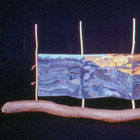
Different things influence my work. The exhibit I had that came out of the floods of '93 was Earthly Moltings. I wasn't able to actually get out there and see the canyon that was created until the very last day that it was open to the public. From then on, I spent the rest of my time just being overcome with the wonder of this place. I'd go, kneel down and take my pictures. I've got the full history of that gorge from that day up until the time it all had to be filled in. Well, I thought, this is my next project. So I worked up an idea for it, and I sent to get permission from the Corps of Army Engineers to climb down in there all by myself and make drawings and take pictures. I worked for almost three years on this show. I went down to the State Historical Museum, researched everything I could find. Then I went through all of the books they have out at Saylorville, the whole history of the building of the dam. I was amassing a lot of shapes and forms and information and things.
I also had fun working in mixed styles, for want of a better word. Some abstract, some kind of expressionistic, some very realistic. I did paintings and I did some prints. I did some drawings. I have a wonderful box elder tree—that summer, this log fell out, and it looked just like a gorge, so I made a sculpture out of it. The Corps of Army Engineers gave me nine soil samples. I divided them in half, fired half of them, ground each one, so I had pigments.
*
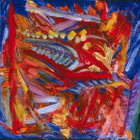
If I have a passion in art, it's color, and then certain shapes and the way they relate to each other. And then how the spirit is expressed in different ways. When I do a painting or something, I do different sketches and then I work it out. I'm very much interested in the geometry of a picture. You can't see that in my work, because that's all hidden.
This series that I'm doing with the auroras is my homage to Wilson. Each one has a palette that is a part of the drawings he made. This is just another discipline for me. Because I like to put myself through different challenges or disciplines. So I'm using this specific palette. For example, the one I'm working on now, I can't use any yellow. I'm very interested in the types of tension that are created between ideas and between shapes and between forms. That fascinates me. It's very interesting.
*
I can't live without sky. I just spent a week in New York. It's very stimulating. You can get a lot of ideas. I'd love to live in New York for one, maybe two, three months out of the year. But I couldn't bear to have just a postage stamp for a sky. My bed is right by the window, and I lay and I look at the sky at night. If I had my druthers, I would live in a house on the top of a hill where I could see the sun rise and the sun set.
I love the change of seasons. I have this wonderful woods that changes constantly. I like the changes, the challenges, what I learn. I don't understand people when they say they get bored—we don't have enough to offer. Huh? There are places you can go for fishing or hiking—I mean, just look out your window for crying out loud. How do you get bored? I don't understand that attitude. I really don't understand it.
*
I would tell young artists just two things, and I have many times. One, the most important person you have to please is yourself. Don't worry whether your work looks like anybody else's—you've got to be true to yourself, to your own spirit. That's the bottom line. And two, find something that you can do so that you can eat, because you have to be able to eat in order to paint. This thing called money is nothing but a tool anyway. All you have to have is enough so you can eat and keep a house over your head and be happy. A lot of people don't. And the third thing is, when you can, share what you do know. I think that's really important. Share your experience, share your work, share your knowledge. There's always time to show somebody how to do something.
*
I enjoy life, and I've been blessed. I've been very, very lucky to be able to do my work. I just hope I'm worthy of having that chance. I've been lucky with wonderful family and wonderful loving friends—you can't ask for much more. Everybody has things that are hard and very, very painful. I sometimes think it's the hard things that keep us young and keep us going. Because if we can learn to face those with grace and good humor—Lord knows, you have to have humor—and love, you can get through almost anything.