
SUSAN COLEMAN
artwork | audio | statement | 2008 update | galleries
artwork
audio 
(see also Making Art in Iowa)
- Early art (47 sec. | 327KB): listen | read
- Best advice (36 sec. | 248KB): listen | read
- Using camera (54 sec. | 372KB): listen | read
- Describing her art (54 sec. | 372KB): listen | read
- Process (36 sec. | 249KB): listen | read
- Advice to new artists (34 sec. | 234KB): listen | read
artist statement
"Exaggerate the essential and keep the obvious vague." —Vincent Van Gogh
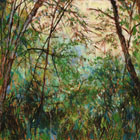
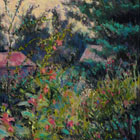
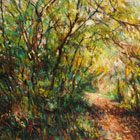
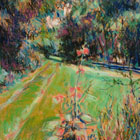
Drawing, Landscape and Metaphor
October 2007
For as long as I can remember I've loved drawing. Over time, the practice of sitting down to really look at something has become part of me. Nature has been a source of inspiration since childhood. Drawing from nature encourages spontaneity and playfulness, because in nature there is more than one right answer.
The search for meaning is at the heart of my interest in landscape. Hope is rekindled by the creative spirit I see revealed in nature and the beauty of this world; rivers that continue to flow, and days that continue to dawn.
Drawing from nature helps me recognize the sacred in the commonplace, something I'd prefer not to take for granted.
Metaphors as old as human memory are embedded in the themes of landscape. The mysteries of nature still exist, and are akin to the mysteries within us. The garden in the wilderness is as ancient as human imagination, and that yearning for a place of peace is as much a part of our inner world as the vague fear of unforeseen tragedy we glimpse in a nightmare, or on any evening newscast.
Despite its long history in western art, I feel that the subject of landscape can serve as a fresh and relevant path for interpreting the human condition. Landscape can make reference to a larger journey.
2008 update
How has your life changed in the years since your interview?
My daughter, who was maybe ten at the time, is now 20 years old. It's pretty cool watching her grow and come into her own. Our conversations are quite different from what they were ten years ago. I no longer work as an adjunct instructor at a community college. I'm now employed full-time as a gallery coordinator / lecturer with the art department at Cornell College, in Mount Vernon. Instead of driving from teaching job to teaching job, I can walk 5 blocks to work. I'm grateful for this change in my life.
What kind of artwork are you doing now?
Landscape is still a dominant theme in my studio work. The local landscape is something I'd prefer not to take for granted, as it seems to have a way of disappearing or morphing into strip malls without some level of vigilance. This beautiful place where I live is very unique. Peaceful yet connected to the larger world. I consider myself blessed to be here.
Drawing still constitutes an essential part of my spiritual practice, though I have to honestly say that time in the studio is harder to come by, or perhaps it’s my energy that’s more at a premium. I have to make time for the studio now.
How has your artwork changed in the last ten years?
I'm sure my artwork has changed in some ways in the past ten years, but I think the changes are subtle. I'm still very much moved by what I see around me. The issue of visual metaphor is still essential to my practice. Sometimes I think it's easier for the audience to see the changes than for the maker of the work.
What motivates you to continue making art?
I still feel that need to continue making art. It's a big part of my spiritual practice. When I neglect to allow myself time in the studio, something feels off. It's like a breathing space for me.
audio text
Early art
I remember as a fourth-grader suddenly becoming extremely popular because I was the kid who could draw Charlie Brown. That was a big deal, because most kids weren't that interested, and see, they would say, "Well, I can't draw." Well, of course they couldn't draw, they didn't draw. You learn how to do it by doing it. If you're sort of obsessed by it a little bit, then you sort of start to succeed on certain levels.
There was a woman, named Marie Lietzinger, who was an artist. My mother heard about her and she decided that I should have lessons. And so, as a child, maybe in fifth grade, I would go to her house once a week, I think on Saturdays, for an hour and learn some things about oil painting and stuff like that. That was pretty neat.
Best advice
Virginia Myers teaches printmaking at Iowa. Probably the first advice she ever gave me and maybe the best advice she ever gave me, was—I'd had kind of a tough critique with someone and I wasn't really sure if I was going to stay in grad school. And she said, "If you're going to make it in this business, you're going to have to have the hide of a rhinoceros and the nose of a rabbit." And it's absolutely true. And she knows, you really have to follow your instincts and you have to be very tough to be an artist.
Using camera
Although I'd been taught never to use a camera in my artwork—at some point I was really getting interested in landscape, and I decided that I'd just take some pictures down at the farm. I found points of view where I wouldn't normally be able to stand to paint or sit to paint. You could climb a tree or you could stand right on the edge of a cliff or in the middle of the highway, if you wanted to. I wasn't trying to copy the photograph. I was really trying to use it as a note-taking device, just to remind me what it was that I had seen there—about the light, about cast shadows, about value contrast, or how many trees there were. Because that way I can work no matter what the weather condition. Or I can work at midnight when everyone's asleep and I don't have to worry about the light changing on me or anything like that.
Describing her art
How would I describe my art? I think it's based on a love of nature. I take a lot of inspiration in looking at forms around me, and I often find that I get some perspective on other issues while I'm drawing. Nature has a way of giving us metaphors for expressing the human condition.
When I was a kid we used to go for these rides in the car for something to do on a hot summer night. And I know that that's part of the reason why I'm a landscape painter. When we're driving home in the evening from work or when I'm just out driving home to see my parents or something, just something wakes up in me when I'm out and seeing that kind of light—that evening light—and my work's about all of those things.
Process
I often don't have a clear picture in my mind of what the image is going to be. It sort of evolves. I may have an idea about a certain kind of field that I'm looking into, or a sky, but it's always kind of like opening a present in a way, when I finally realize that the piece is finished, or this is the best I can do. It's finished. And I'm often surprised at what came to pass, because while I'm working I'm not always conscious of every single move I make. I'm not in control. There are other things at work—I don't know what they are—that sort of guide me.
Advice to new artists
Do your work. Try not to take things too personally. Listen, take what's nourishing, and let the rest roll off—because not everything that's said to you will really be about you, at all. Be as open to possibility as you can.
Everyone has ambivalence and everyone has good feelings about their life. But, I can't imagine not being an artist. It's been really very nourishing. I just can't picture any other vocation.