
BARBARA BRUENE
artwork
audio 
(see also Making Art in Iowa)
- Signs (60 sec. | 410KB): listen | read
- The artwork (57 sec. | 389KB): listen | read
- The process (37 sec. | 255KB): listen | read
- Being an artist (56 sec. | 380KB): listen | read
- The response (40 sec. | 277KB): listen | read
- Advice (31 sec. | 215KB): listen | read
audio text
Signs
I did a lot of signage for my father's grocery store, and I enjoyed that. But it never occurred to me that lettering could be art. But recently I looked at the full-page advertisement that I had done for my family's grocery store. I had used two different alphabets, and I had alternated in a sense, dark and light, and I had alternated texture, which is a really simple way of saying pretty much what I've done ever since. But I sure didn't know that at the time. And certainly didn't think of that as art.
There was a home economics teacher, Mrs. Edith Murren, who was influential. And I think maybe the fact my mother had a degree in home economics, and then she was influential as well, probably had a lot to do with why I chose home economics when I first went off to undergraduate school. The lucky thing for me was that home economics at Iowa State included the art department. So right away I took some art classes. It was clear to me by the time I was ready to declare a major, that art would be my major.
The artwork
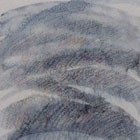
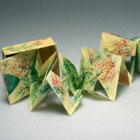
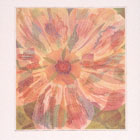
One of the things I like about letters has to do with their shapes—the interior shapes as well as the lines themselves. My work is usually really colorful, a lot of saturated color. I think each line of writing has a kind of texture to it—just like a different brush stroke or a pencil or a different tool makes a particular kind of mark—so that I'm almost drawing with a line of writing. And I'm real interested in what the content of those words is. And I'm very interested in composition. I love working out that puzzle in each piece, of balancing the elements, of making them do something interesting. All the lettering that I do uses gouache, and then I use transparent watercolor a lot. A kind of secondary media would be pastels, which I'm using as dust; I'm rubbing them into the paper.
The process
The wonderful thing about doing art, I think, is all the things that happen in the process of actually doing it—when working with the materials. And the materials won't always do what you would like them to do; that, therefore, sends you in another direction. Or they do something wonderful that you hadn't anticipated and then you can run with that. So I'm pretty fast onto a full-size sheet of watercolor paper. And then I'm pretty impatient. I really like to get color going. And usually I don't like it at first, I don't like what I first put down. But I love working in layers, so I like density of imagery, and layering.
Being an artist
Much as a writer composes with words, a visual artist composes with materials and imagery. There's a really deep satisfaction in solving a problem, causing the elements to express what you want. And once it's finished, it almost becomes outside of yourself. I mean, I certainly care about it. But somehow it's kind of on the exterior, and all the process is interior. And I like them when they're done, but the great pleasure is in the doing. And it seems necessary to me to do—I have lots of other things that I enjoy doing, but I do at some point become tense or edgy or something if I'm not spending some of my time making art. But the good thing about that is it's fairly easy to solve. I know what to do!
The response
I'm most delighted, I guess, when people bring their own experiences to it. I really enjoy hearing people talk about their own lives, in a sense triggered by something they saw in the work. I think of the words almost like life drawing or figure drawing—any painting that has a realistic image of a person in it has a certain kind of power. And I think words have some of that same kind of power. So it brings out sort of interesting things. And I think all art does that. You respond—it reminds you of your own experiences somehow, even if it's just a gutsy good feeling about a painted surface of some sort. Something in you responds to it.
Advice
Talent used to be a word that people were concerned about, and I think sometimes students still wonder about that—do I have talent? But what you have to have to be good in any field, whether it's physics or agronomy or art, is you have to be incredibly interested in it. And then you have to work really hard at it; you do have to put in a tremendous amount of time. And you won't do that unless you really, really love it—unless you're really getting a lot of satisfaction from it. So it will tell you if that's not what you should be doing.