
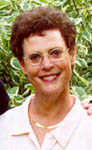
SARA SLEE BROWN
artwork | audio | statement | 2008 update | galleries
artwork
audio 
- Child art (46 sec. | 320KB): listen | read
- College (47 sec. | 327KB): listen | read
- Therapy (64 sec. | 436KB): listen | read
- My art (41 sec. | 282KB): listen | read
- Being an artist (43 sec. | 293KB): listen | read
- Advice (60 sec. | 406KB): listen | read
artist statement
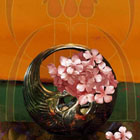
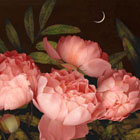
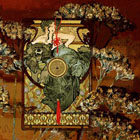
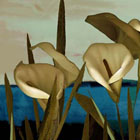
After many years of oil painting, gauche and mixed media work I discovered the power and beauty of digital imaging. This medium has opened up a new world of imagery for me. The work is created by placing some of my favorite objects down on my scanner and using the scanner as a camera. After I have created an image I refine it in my computer.
Sometimes this work is very simple and little alteration occurs. Other times the image is reworked many, many times, often at the single pixel level. For me the works evoke a sense of quiet, beauty and serenity that I find very satisfying.
May 2008
2008 update
How has your life changed since the interview?
Two months after the interview I was diagnosed with breast cancer and immediately had a single mastectomy. In January 1999 I began chemotherapy treatments which were completed at the end of July. Following that I had 6-1/2 weeks of radiation therapy. It was a difficult time when all my energy and thoughts were focused on getting well. The treatment I received here in Iowa City at the University of Iowa was outstanding and the support of my friends at the Iowa City Public Library and family was overwhelming. I am very grateful to everyone who helped me in my recovery. As a consequence of facing the uncertainty of this traumatic situation I was forced to consider the possibilities of the outcome as well as the effects it would have on my loved ones. The choices of behavior and attitude made during this crisis by me, my husband, daughter and son created a strong, positive bond which continues to be a joy to all of us. I am a cancer survivor.
Our family began to grow in 2005 when my son married and gave us our first grandson. In 2007 my husband and I retired, my mother passed away and our daughter got married. We are expecting our second grandchild any day now.
How has your artwork changed in the last ten years?
When I resumed making artwork in 2000 I was somewhat unfocused. Then I read an article about a photographer who had begun using a flatbed scanner to take pictures of flowers with beautiful results. I was intrigued with this idea and so began to experiment with the technique myself as I already had all of the necessary equipment. I soon became enchanted with the method and results I was able to produce with this new medium. I have been making my art using it ever since.
What motivates you to continue making art?
Making art is the one activity that allows me to express myself in a deeply satisfying way. Being in the flow of creativity is completely satisfying.
What advice do you have to give others?
Find your own voice and do what you have to do to express it.
audio text
Child art
My mother was a painter herself and was trained, and got an undergraduate degree in painting. She did oil paintings—did portraits and some street scene kind of thing. She did that when we were young and then she stopped doing that maybe when I was in high school. My mother fostered the arts in the family. My brother, who's younger than I, is a painter as well—an artist. He's always been an artist.
My father was an only child of a Methodist minister, and so the Methodist church and church—going was very dominant in my childhood. And so, we had to draw the Christmas card every year, and from a very early age. So that was sort of art on demand. I was pretty interested in it; at school, it was easy for me, but I was never singled out by the teacher.
College
I got a B.F.A. And I got my teaching certificate in K through 12. So I did student teaching. But then I never taught. And I graduated from college in 1968, which was the year, you know, that King was assassinated and Kennedy was assassinated and the riots were in Detroit—which was very close. We had curfews and stuff. I remember being very afraid. Everything happened that year. And then, I got married in August of that summer of '68.
And I think I started graduate school in '78. Then I started to be more serious about it. I guess I had decided that I would do art and that I would get a formal education in that. I didn't have a plan that I would be a teacher or anything like that. I was just going to do art.
Therapy
We moved to Vermont for a year, because my husband did a sabbatical, and my kids were in fifth grade and second grade. And I did art there, I had a studio in the house, and I did a lot of nice pieces of oil paintings—but I just couldn't keep it going anymore. So I came in to have my physical at the hospital, and my doctor said, "Well, oh you're fine physically. How're you doing?" And I said, "Well, I am so mad! Just furious!" And he said, "Well, you need to go talk to somebody." So he wrote me a prescription on a prescription pad of the Community Mental Health Center and the phone number. And so, then I started therapy. I was about 35 years old—maybe a little older.
I really had no idea what my needs were or how to address them to get them met at all. That was what the anger was—that meeting everybody else's needs. So, I was very depressed for a long time. When my son, who's the youngest of my two children, graduated and left the house, I made a little studio out of his bedroom, so I could start.
My art
My art these days is much more about me and stuff I'm interested in. And I told my daughter, I said, "Well now, I'm just going to do stuff that's fun and that's about me." And she said, "I hate to tell you this mom, but that's what most people do." So, my art today is stuff that I'm interested in, that I want to tell a story about, or that I want to do something with. Some of it's autobiographical, but some of it isn't. The still life and my family, my immediate loved ones, is still a very strong primary.... But I've also put myself in there more now, whereas before I didn't used to do that.
Being an artist
It gives you a pretty interesting perspective on the world and on life. The sensitivity is something I think that an artist has to come to terms with, because it goes both ways. Because things that happen in the world—the bad stuff—affects one, but it also allows me to see the beauty and the pain in a deep manner, in a deep way. So it gives me a unique perspective.
When I'm in there working, that just is very satisfying. It's good to have an end piece. I like to have that to send out to the world, and then whatever the world does, I don't have much control over. But it's not as important as actually making the art.
Advice
Life is very complicated, and there's a lot more to being an artist—for me, anyway—than just being in the studio. All the therapy, all the hours and years of reading and studying things—that's what I bring to the studio. And so what I'm doing in the studio now is so different than what I was doing, because I've changed so much. Not the essence of me, but there's so much more information that I can bring to it about me. That, for me, is very important—for who I am as an artist.
You have to be true to yourself and find your own voice, and then speak your own voice. Those things can be very difficult, and it might take you awhile to get there. And so if you really want to do it, you're going to have to be persistent and keep trying. But that would be the contribution that you could make, would be your voice.